Hydrolysis of Sucrose by Invertase for Industrial Invert Sugar
Optimize sucrose hydrolysis by invertase for invert sugar with pH, temperature, dosing, QC, COA/TDS/SDS, and supplier guidance.
A practical B2B guide to using invertase enzyme for controlled sucrose conversion, consistent invert sugar quality, and supplier-ready process validation.
What the Hydrolysis of Sucrose by Invertase Does
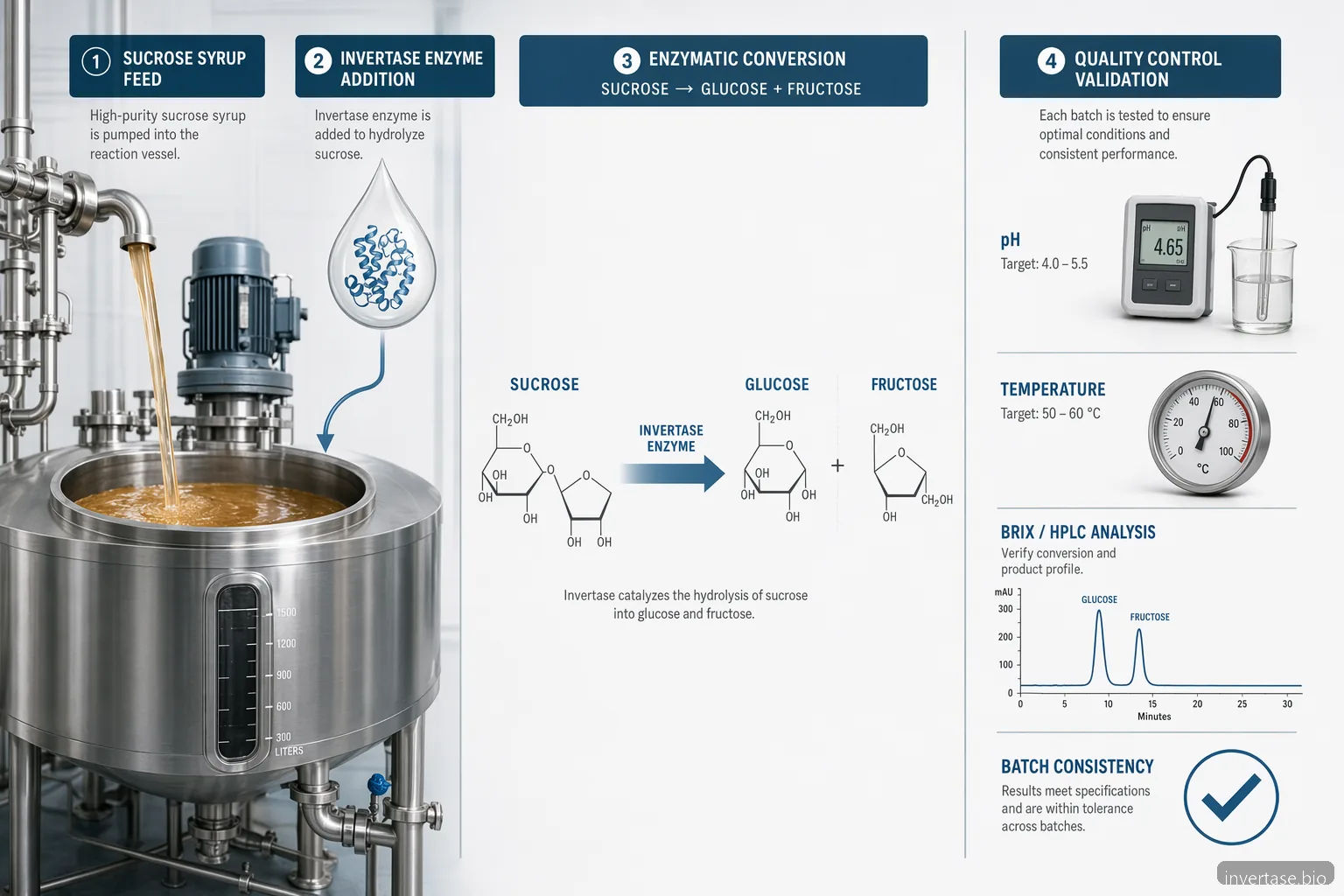
The hydrolysis of sucrose by invertase is an enzyme-catalyzed reaction that splits sucrose into glucose and fructose. In food manufacturing, this reaction is used to produce invert sugar with controlled sweetness, crystallization behavior, viscosity, and humectancy. The same enzyme is also called sucrase in biochemical contexts, but industrial buyers usually specify invertase enzyme by activity, formulation, and application fit. For invert sugar production, the process starts with a prepared sucrose syrup, adjustment to the selected pH and temperature, addition of invertase, and monitoring until the target degree of inversion is reached. The commercial objective is not simply maximum conversion; it is repeatable conversion within a defined production cycle, compatible sensory profile, and predictable downstream performance in confectionery, bakery fillings, syrups, and honey processing blends.
Reaction: sucrose plus water yields glucose and fructose. • Primary application: controlled invert sugar production. • Key control point: degree of inversion at the required Brix.
Recommended Process Conditions for Invert Sugar
Process conditions should be confirmed against the selected product TDS, because invertase activity varies by source, formulation, and declared activity unit. As a practical starting point, many industrial sucrose invertase processes operate at pH 4.0 to 5.5 and 45 to 60 °C. Lower temperatures may work with longer contact time, while higher temperatures can reduce enzyme stability if held too long. Sucrose solids are commonly prepared as a syrup in the 55 to 70 °Brix range, provided mixing and heat transfer remain adequate. Dosage often begins in pilot trials around 0.02% to 0.20% enzyme preparation by syrup weight, then is adjusted based on activity, conversion target, and cycle time. The best operating point balances conversion, color control, microbial control, energy use, and enzyme cost-in-use.
Typical pH: 4.0 to 5.5, subject to TDS confirmation. • Typical temperature: 45 to 60 °C for many preparations. • Pilot dosage band: 0.02% to 0.20% by syrup weight. • Confirm endpoint by reducing sugar or HPLC method.
How Does Invertase Break Down Sucrose?
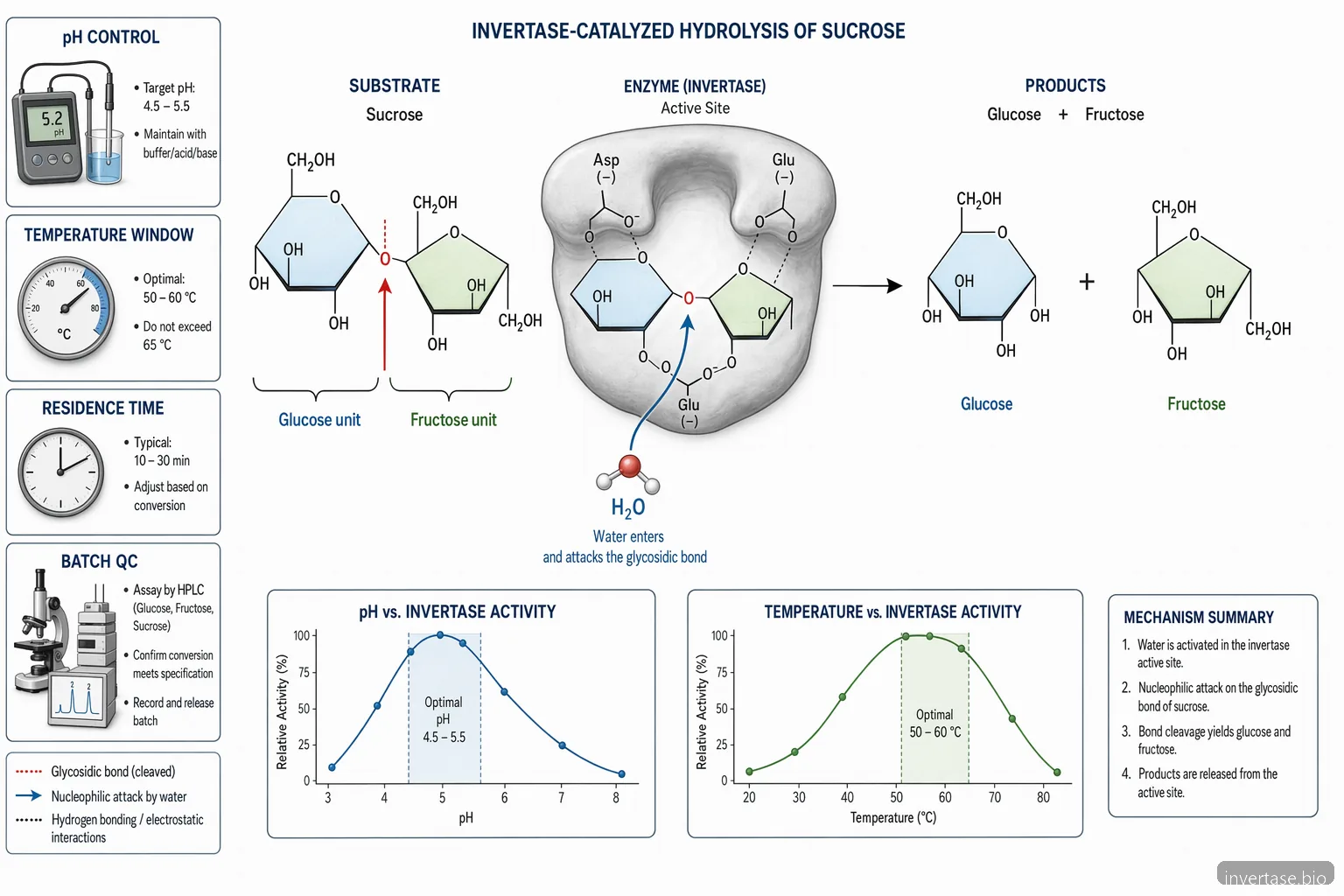
For buyers asking how does invertase break down sucrose, the practical answer is that the enzyme lowers the activation energy for glycosidic bond cleavage in sucrose. Water participates in the reaction, and the products are glucose and fructose. In production, invertase reaction with sucrose is influenced by substrate concentration, pH, temperature, residence time, agitation, and enzyme activity. Very high Brix improves solids efficiency but can slow mass transfer and increase viscosity, so mixer design and heat distribution matter. A well-controlled sucrose hydrolysis by invertase process avoids overlong hold times that may contribute to unnecessary color development or schedule delays. For consistent invertase sucrose conversion, manufacturers should define an endpoint such as percentage inversion, reducing sugar value, or glucose/fructose profile rather than relying only on elapsed time.
Main products: glucose and fructose. • Control variables: pH, temperature, Brix, time, and dosage. • Endpoint should be analytical, not only time-based.
QC Checks for Batch Consistency
Quality control should be designed around the product specification and the customer’s downstream use. Core in-process checks include syrup Brix, pH before and after conversion, temperature profile, reaction time, and appearance. Conversion can be monitored by reducing sugar titration, enzymatic sugar assays, polarimetry, or HPLC where profile detail is required. Finished invert sugar should be assessed for target solids, reducing sugars, ash or conductivity if relevant, color, odor, microbial limits, and absence of visible foreign matter. For confectionery or filling applications, additional functional checks such as crystallization tendency, viscosity, water activity, and storage stability may be useful. Each lot of invertase should be received with a COA, and production teams should retain traceability between enzyme lot, syrup batch, operating conditions, and final QC results.
Check Brix, pH, temperature, and conversion endpoint. • Use reducing sugar, polarimetry, enzymatic assay, or HPLC. • Link enzyme lot traceability to finished syrup results. • Evaluate viscosity or crystallization for confectionery use.
Supplier Qualification and Documentation
An industrial invertase supplier should provide documentation that supports technical review, purchasing approval, and plant-level risk assessment. At minimum, request the COA for lot-specific activity and quality data, the TDS for recommended application conditions, and the SDS for handling, storage, and safety information. Buyers may also request origin information, carrier or diluent details, allergen statements, GMO status where relevant to the market, and suitability statements for vegetarian or vegan positioning. Invertase vegan claims should be verified from the enzyme source, processing aids, and supplier documentation rather than assumed. Supplier qualification should also review lead time, packaging size, storage temperature, shelf life, change notification practice, and technical support. Avoid evaluating price per kilogram alone; compare delivered enzyme activity and conversion performance in your syrup system.
Request COA, TDS, and SDS before plant trials. • Verify source, carrier, allergen, and suitability statements. • Compare cost-in-use, not only unit price. • Assess lead time, packaging, shelf life, and support.
Pilot Validation Before Commercial Scale
Pilot validation converts supplier data into plant-specific operating instructions. A practical trial matrix should vary pH, temperature, enzyme dosage, Brix, and residence time around the proposed operating window. Record the same QC values that will be used in routine manufacturing, including conversion endpoint and any sensory or functional checks required by the customer. If the invert sugar will be used in confectionery, validate the impact on graining, chew texture, filling flow, and shelf stability under realistic storage. If it will be used in honey processing or syrup blending, confirm color, flavor impact, and label or processing-aid requirements with your regulatory team. Scale-up should confirm agitation, heating and cooling rates, enzyme addition point, hold tank residence time, and cleaning procedure. The final commercial dosage should be based on cost-in-use at the required conversion and cycle time.
Run trials across pH, temperature, dosage, Brix, and time. • Confirm performance in the final application matrix. • Validate scale-up mixing, heat transfer, and hold time. • Set dosage by conversion economics and production schedule.
Technical Buying Checklist
Buyer Questions
Many industrial invertase processes start around pH 4.0 to 5.5, but the best pH depends on the enzyme preparation, syrup solids, temperature, and desired conversion time. Buyers should use the supplier TDS as the initial reference and confirm performance through pilot trials. Routine production should verify pH before enzyme addition and after conversion.
A practical starting range is often 45 to 60 °C for invert sugar production, subject to the supplier’s data sheet. Higher temperatures can accelerate the reaction but may reduce enzyme stability if exposure is excessive. Lower temperatures may be suitable when longer hold time is acceptable. Pilot testing should define the best balance of speed, color control, and enzyme cost.
Dosage is usually calculated from syrup weight, enzyme activity, target degree of inversion, Brix, pH, temperature, and available residence time. A common pilot range is about 0.02% to 0.20% enzyme preparation by syrup weight. Commercial dosage should be finalized by analytical conversion data and cost-in-use, not by generic percentage alone.
Invertase vegan suitability depends on the enzyme source, fermentation inputs, carriers, and processing aids. Many commercial preparations are microbial or fungal in origin, but buyers should not assume suitability without documentation. Request supplier statements covering origin, formulation components, allergen position, and any market-specific requirements. Your regulatory team should confirm how the enzyme is treated in the finished product.
“Invertase 10 lettres” is a French-style crossword or word-search query meaning invertase has 10 letters. It is not usually a purchasing term. Industrial buyers should focus on application terms such as invertase enzyme, sucrose invertase, invertase confectionery, and hydrolysis of sucrose by invertase when comparing technical performance, documentation, and supplier capability.
Get a Free Sample & Quote
Share your application, target pH/temperature, and annual demand. We'll recommend the right activity grade and send a free sample with COA/TDS within 24 hours.
Frequently Asked Questions
What is the best pH for hydrolysis of sucrose by invertase?
Many industrial invertase processes start around pH 4.0 to 5.5, but the best pH depends on the enzyme preparation, syrup solids, temperature, and desired conversion time. Buyers should use the supplier TDS as the initial reference and confirm performance through pilot trials. Routine production should verify pH before enzyme addition and after conversion.
What temperature should be used for sucrose hydrolysis by invertase?
A practical starting range is often 45 to 60 °C for invert sugar production, subject to the supplier’s data sheet. Higher temperatures can accelerate the reaction but may reduce enzyme stability if exposure is excessive. Lower temperatures may be suitable when longer hold time is acceptable. Pilot testing should define the best balance of speed, color control, and enzyme cost.
How is invertase dosage calculated for invert sugar syrup?
Dosage is usually calculated from syrup weight, enzyme activity, target degree of inversion, Brix, pH, temperature, and available residence time. A common pilot range is about 0.02% to 0.20% enzyme preparation by syrup weight. Commercial dosage should be finalized by analytical conversion data and cost-in-use, not by generic percentage alone.
Is invertase vegan for industrial food applications?
Invertase vegan suitability depends on the enzyme source, fermentation inputs, carriers, and processing aids. Many commercial preparations are microbial or fungal in origin, but buyers should not assume suitability without documentation. Request supplier statements covering origin, formulation components, allergen position, and any market-specific requirements. Your regulatory team should confirm how the enzyme is treated in the finished product.
Related: Invertase for sugar inversion and liquid-centre production
Turn This Guide Into a Supplier Brief Request an invertase COA, TDS, SDS, and pilot sample to validate invert sugar performance in your process. See our application page for Invertase for sugar inversion and liquid-centre production at /applications/invertase-buy-hong-kong/ for specs, MOQ, and a free 50 g sample.
Get a Free Sample & Quote