Invertase Dosage, pH, and Temperature in Invert Sugar Production
Troubleshoot invertase for invert sugar: dosage, pH, temperature, QC checks, COA/TDS/SDS review, pilot validation, and suppliers.
A practical B2B guide for process teams troubleshooting invertase performance, conversion rate, syrup quality, and supplier selection for industrial invert sugar.
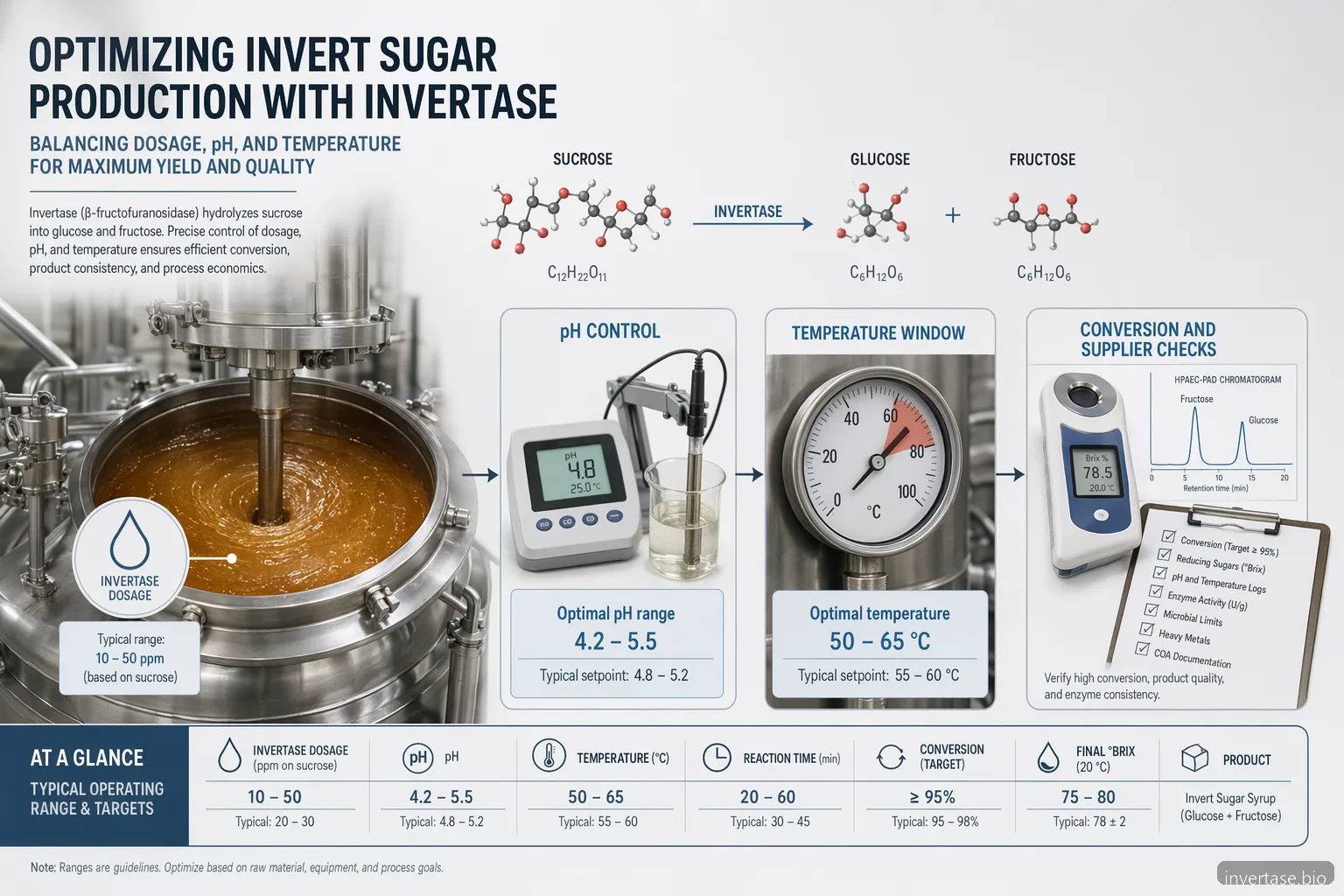
What is invertase in industrial invert sugar?
Invertase, also called sucrase or beta-fructofuranosidase, is an invertase enzyme used to split sucrose into glucose and fructose. To define invertase for a process specification, it is a biocatalyst for invertase sucrose hydrolysis, not a sweetener by itself. The invertase meaning is therefore tied to conversion: it helps produce invert sugar with different crystallization behavior, sweetness profile, humectancy, and syrup handling properties compared with untreated sucrose syrup. In confectionery, bakery fillings, fondants, and honey processing, buyers usually evaluate invertase by activity, recommended pH range, thermal tolerance, carrier system, regulatory fit, and consistency between lots. The relevant invertase structure and origin may affect stability, formulation compatibility, and dietary positioning, so it should be reviewed through supplier documentation rather than assumed from a generic enzyme description.
Common names: invertase, invertase enzyme, sucrase. • Primary reaction: sucrose to glucose plus fructose. • Main B2B use: controlled invert sugar production.
Starting dosage bands and pilot validation
There is no universal invertase dosage because activity units, formulation strength, sucrose concentration, residence time, and process temperature vary by supplier and plant. For troubleshooting, start with the supplier TDS dosage recommendation and run a small design of experiments rather than increasing enzyme blindly. Many industrial trials evaluate low, medium, and high dosage bands across the expected Brix and pH range, then measure conversion over time. The correct commercial dose is the lowest level that achieves the target residual sucrose and syrup quality within the required cycle time. Buyers should compare cost-in-use, not only quoted price, because a more concentrated or more stable product can reduce holding time, tank occupancy, rework, and energy exposure. Always confirm results at pilot scale before plant-scale purchase commitments.
Run side-by-side trials using equal activity units where possible. • Track conversion curve, not only final sweetness. • Validate dosage under actual plant Brix and sanitation conditions. • Calculate cost per metric ton of finished invert sugar.
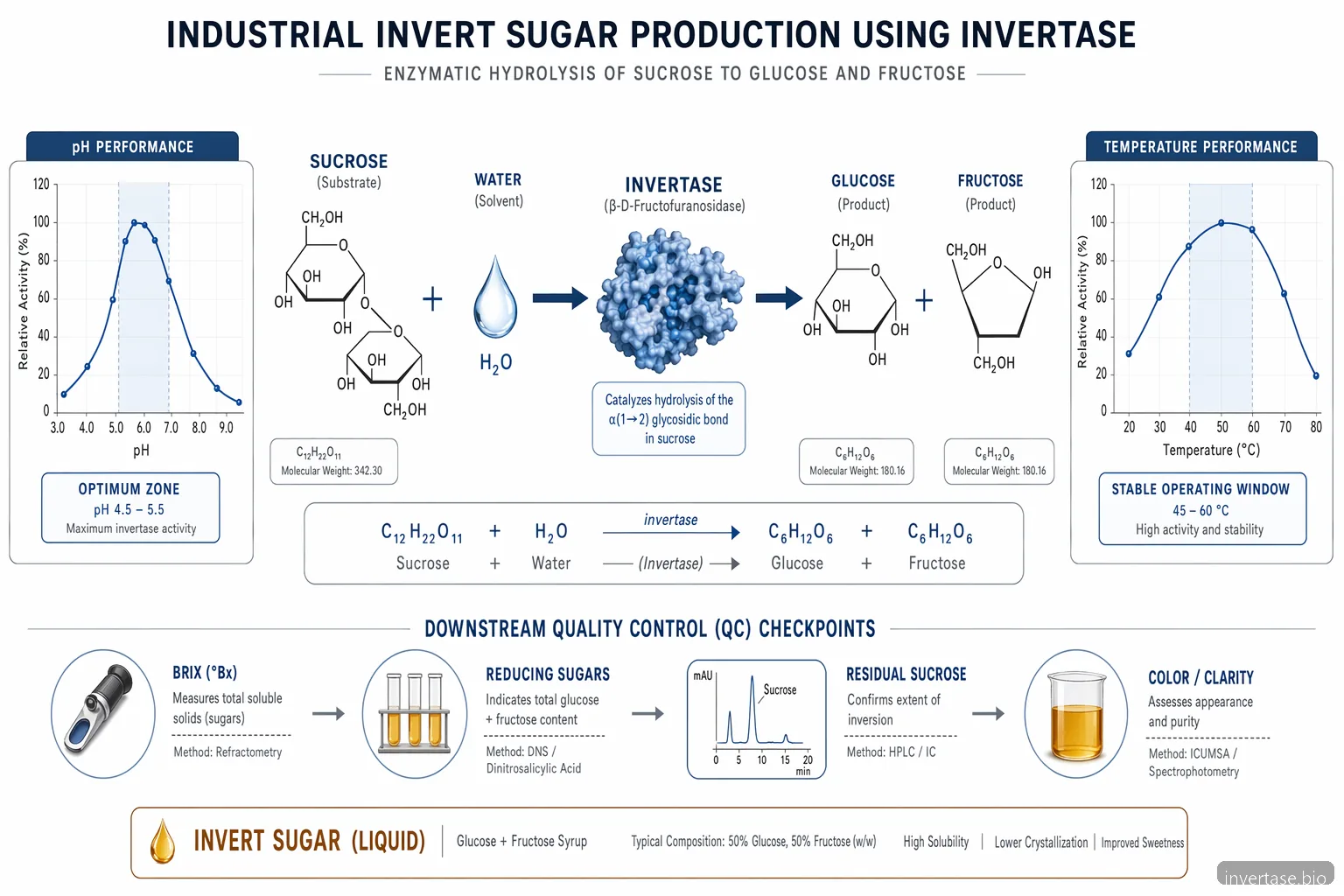
pH and temperature conditions that affect conversion
Invertase commonly performs best in mildly acidic syrup systems, but the exact operating window depends on enzyme source and formulation. As a practical starting point, many invert sugar trials examine pH around 4.0 to 5.5 and temperatures around 45 to 60 degrees Celsius, then refine using the supplier TDS. Higher temperatures may accelerate reaction initially but can shorten enzyme life if the product is not heat-stable. Lower temperatures may protect activity but extend holding time. pH drift is a frequent cause of inconsistent conversion, especially in high-Brix syrups where sampling and mixing errors can hide local variation. Process teams should measure pH at production temperature or apply appropriate temperature compensation, verify probe calibration, and confirm that acidulants, minerals, preservatives, or carryover cleaning chemistry do not inhibit the enzyme.
Typical trial pH: about 4.0 to 5.5, subject to TDS confirmation. • Typical trial temperature: about 45 to 60 degrees Celsius. • Avoid assuming heat stability without supplier data. • Control mixing before sampling pH or Brix.
QC checks for troubleshooting slow or incomplete inversion
When an invert sugar batch misses conversion targets, the root cause is often process control rather than enzyme failure alone. QC should confirm the incoming sucrose syrup concentration, initial Brix, pH, enzyme addition point, dosing accuracy, tank temperature profile, and hold time. Analytical checks may include residual sucrose by HPLC or validated enzymatic methods, reducing sugar tests, refractometry, color, sensory evaluation where applicable, and microbial controls. Retain enzyme lot numbers and compare the COA activity against internal performance data. If conversion is slow, review whether the enzyme was exposed to excessive heat, incompatible pH, long storage after opening, or cleaning chemical residues. If color increases, assess time-temperature exposure and syrup impurities before raising the enzyme dose.
Confirm dose by calibrated pump, not estimated addition. • Check residual sucrose and reducing sugars on a defined schedule. • Compare current enzyme lot against a retained reference lot. • Document temperature history during holding and transfer.
Supplier qualification and purchasing documentation
For B2B procurement, invertase should be sourced through a documented supplier qualification process. Request a current COA for each lot, a TDS showing activity definition and recommended use conditions, and an SDS for handling, storage, and workplace safety review. Depending on the market, buyers may also request origin, allergen, GMO, kosher, halal, vegetarian, or invertase vegan statements, but these should come from the supplier’s controlled documents rather than marketing assumptions. Review shelf life, storage temperature, packaging size, preservative system, and traceability. A technically responsive supplier should support pilot validation, explain activity units, provide sample quantities, and help troubleshoot conversion without overstating performance. Final approval should be based on plant data, documentation fit, supply reliability, and total cost-in-use.
Request COA, TDS, and SDS before approval. • Confirm activity unit definition and assay method. • Review storage, shelf life, packaging, and traceability. • Qualify with pilot results before routine purchasing.
Technical Buying Checklist
Buyer Questions
Invertase is an enzyme that hydrolyzes sucrose into glucose and fructose. In industrial invert sugar production, it is added to a controlled sucrose syrup under suitable pH, temperature, and holding time. The goal is not simply to add enzyme, but to reach a specified conversion level while maintaining color, flavor, Brix, microbial control, and batch consistency.
Start with the dosage band in the supplier TDS because activity units and formulations differ. Run low, medium, and high dose trials under your actual Brix, pH, temperature, and hold time. Select the lowest dose that meets residual sucrose and quality targets within the production schedule. For purchasing, compare cost-in-use per ton of finished syrup, not just enzyme price.
Common causes include pH outside the enzyme’s working range, insufficient temperature control, high Brix limiting mass transfer, poor mixing, inaccurate dosing, expired or poorly stored enzyme, or exposure to cleaning chemical residues. Confirm pH calibration, temperature history, and actual enzyme addition. Then compare residual sucrose and reducing sugar data against a reference batch and the COA activity.
Invertase vegan status depends on the enzyme source, fermentation medium, carriers, processing aids, and supplier documentation. Do not assume vegan suitability from the word invertase alone. For B2B approval, request a current dietary or vegan statement, plus COA, TDS, and SDS. If labeling or customer specifications are involved, confirm requirements with regulatory and quality teams before commercial use.
The phrase invertase 10 lettres often appears in French-language search behavior or crossword-style queries, where users are looking at the word length rather than industrial enzyme performance. For B2B buyers, the important terms are invertase, sucrase, invertase enzyme, activity units, pH range, temperature stability, and sucrose hydrolysis performance in validated invert sugar trials.
Get a Free Sample & Quote
Share your application, target pH/temperature, and annual demand. We'll recommend the right activity grade and send a free sample with COA/TDS within 24 hours.
Frequently Asked Questions
What is invertase and how does it make invert sugar?
Invertase is an enzyme that hydrolyzes sucrose into glucose and fructose. In industrial invert sugar production, it is added to a controlled sucrose syrup under suitable pH, temperature, and holding time. The goal is not simply to add enzyme, but to reach a specified conversion level while maintaining color, flavor, Brix, microbial control, and batch consistency.
What dosage of invertase should an industrial plant use?
Start with the dosage band in the supplier TDS because activity units and formulations differ. Run low, medium, and high dose trials under your actual Brix, pH, temperature, and hold time. Select the lowest dose that meets residual sucrose and quality targets within the production schedule. For purchasing, compare cost-in-use per ton of finished syrup, not just enzyme price.
Why is my invertase conversion slower than expected?
Common causes include pH outside the enzyme’s working range, insufficient temperature control, high Brix limiting mass transfer, poor mixing, inaccurate dosing, expired or poorly stored enzyme, or exposure to cleaning chemical residues. Confirm pH calibration, temperature history, and actual enzyme addition. Then compare residual sucrose and reducing sugar data against a reference batch and the COA activity.
Is invertase vegan for confectionery or invert sugar applications?
Invertase vegan status depends on the enzyme source, fermentation medium, carriers, processing aids, and supplier documentation. Do not assume vegan suitability from the word invertase alone. For B2B approval, request a current dietary or vegan statement, plus COA, TDS, and SDS. If labeling or customer specifications are involved, confirm requirements with regulatory and quality teams before commercial use.
Related: Invertase for sugar inversion and liquid-centre production
Turn This Guide Into a Supplier Brief Request an invertase sample, COA/TDS/SDS package, and pilot-trial support for your invert sugar process. See our application page for Invertase for sugar inversion and liquid-centre production at /applications/invertase-buy-hong-kong/ for specs, MOQ, and a free 50 g sample.
Get a Free Sample & Quote