Invertase Enzyme Powder: Specification Checklist for Invert Sugar
Compare invertase enzyme powder for invert sugar: specs, process ranges, COA/TDS/SDS, dosage, QC, supplier qualification.
For industrial syrup, confectionery, and honey-processing teams, the right invertase enzyme powder is selected by activity, process fit, documentation, and cost-in-use—not by headline price alone.
What Is Invertase Enzyme Powder?
Invertase enzyme powder is a dry industrial enzyme preparation used to split sucrose into glucose and fructose. In technical terms, invertase is a beta-fructofuranosidase; in many purchasing searches it also appears as sucrase. If your team asks, "is invertase an enzyme?" the answer is yes: it is the enzyme responsible for sucrose hydrolysis. The practical invertase enzyme function is to produce invert sugar with controlled sweetness, crystallization behavior, humectancy, and fermentable sugar profile. For B2B buyers, the key comparison is not simply whether a product contains invertase, but whether its activity, carrier, solubility, and impurity profile match your process. A search such as "invertase 10 lettres" may identify the word, but procurement needs a much deeper checklist: documented specifications, stable supply, technical support, and pilot data under your actual syrup conditions.
Primary substrate: sucrose • Primary products: glucose and fructose • Common applications: invert sugar, confectionery centers, syrups, and honey processing
Process Conditions for Invert Sugar Production
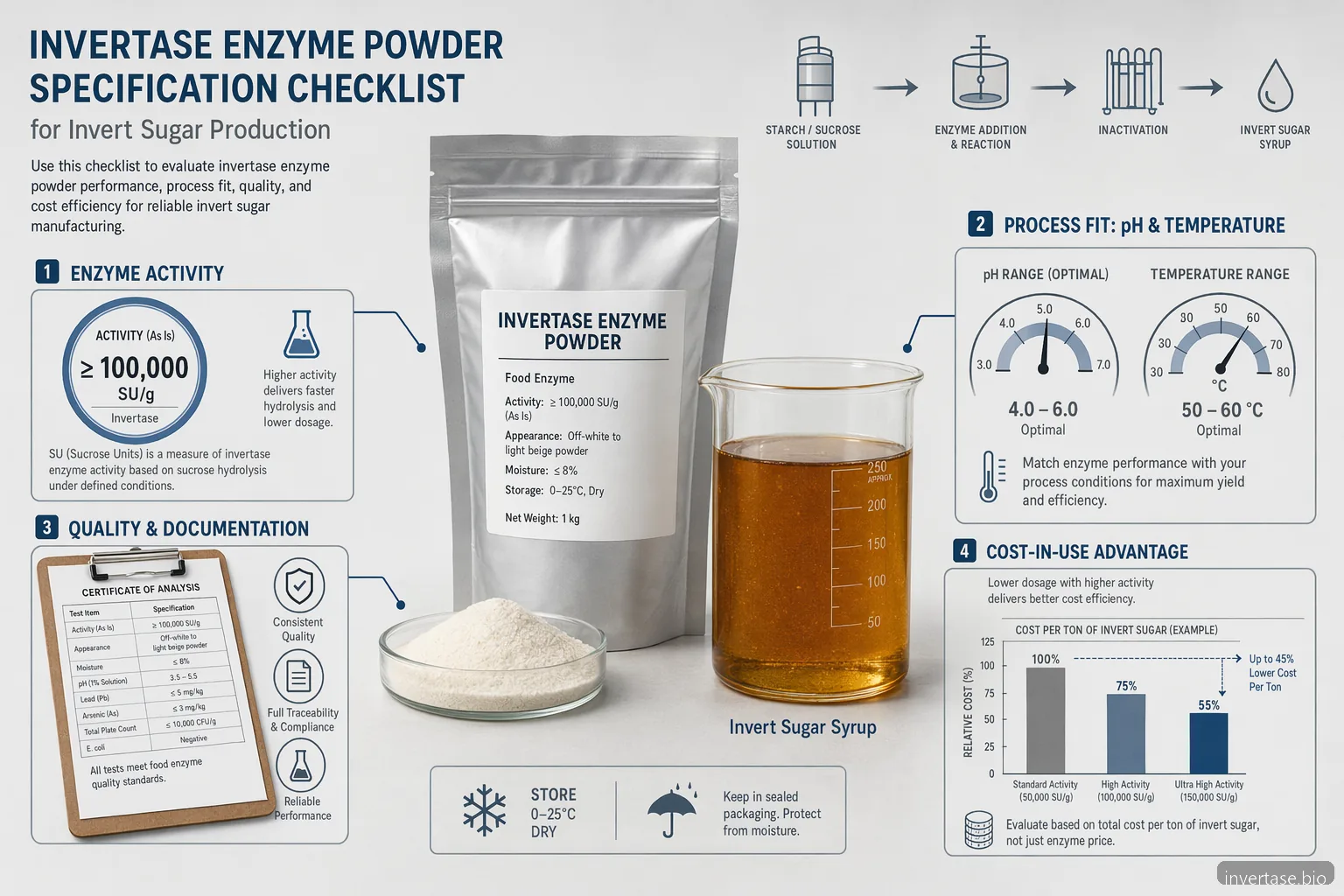
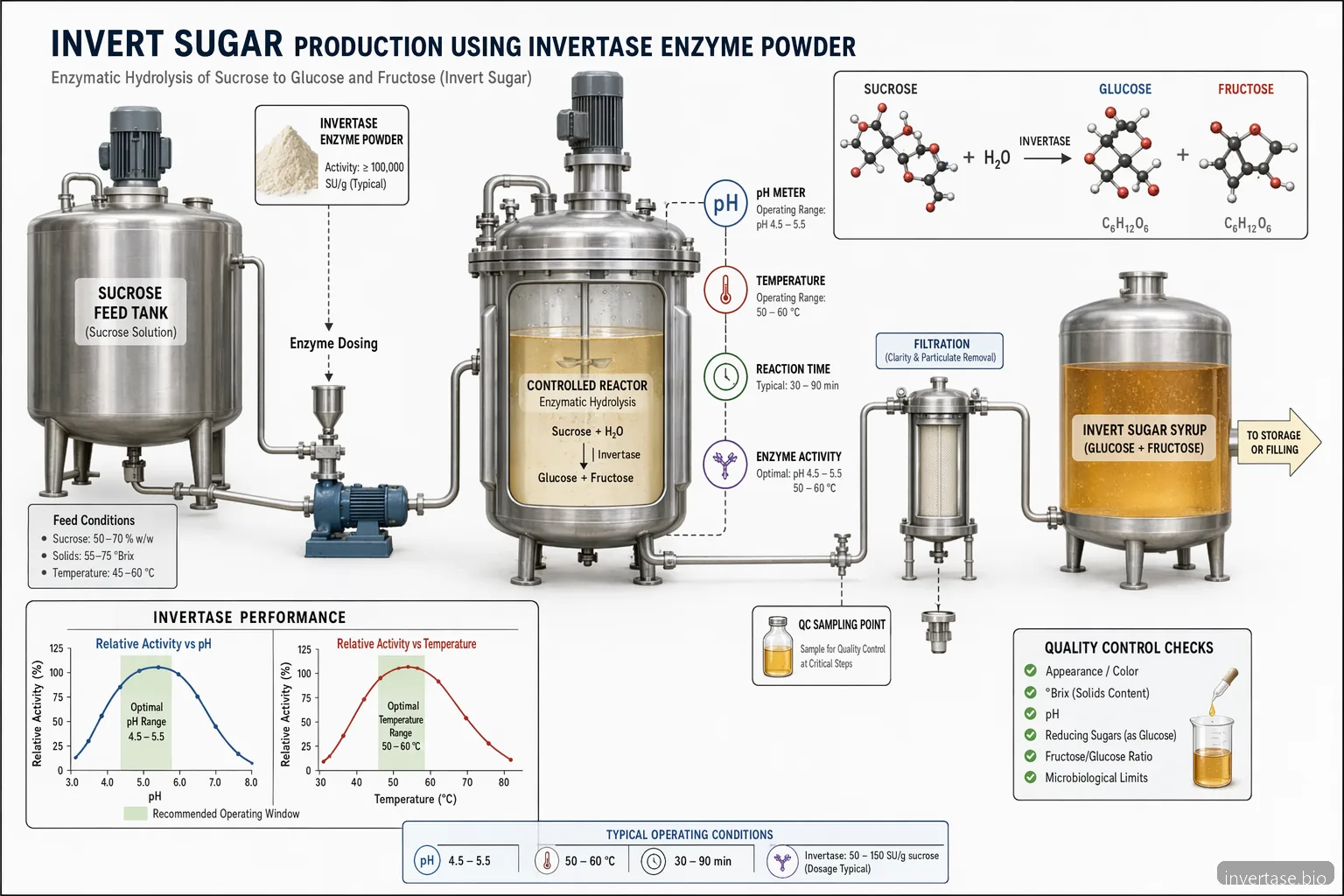
Invertase performance depends strongly on pH, temperature, dry solids, and contact time. Many industrial invertase enzyme products operate effectively in mildly acidic syrup, commonly around pH 4.0 to 5.5, with a practical target near pH 4.5 to 5.2 for sucrose inversion. Temperature is often selected in the 45 to 60 °C range to balance reaction speed with enzyme stability; excessive heat can reduce activity, so thermal hold steps should be validated before production. Syrup concentration may range from roughly 50 to 75 °Brix, but high solids can slow mass transfer and extend inversion time. Initial dosage is usually screened by enzyme activity units rather than powder weight because potency varies by supplier. A practical trial matrix compares dosage, pH, temperature, and time until the desired reducing sugar or residual sucrose endpoint is reached.
Typical pH screen: 4.0, 4.5, 5.0, and 5.5 • Typical temperature screen: 45, 50, 55, and 60 °C • Track residual sucrose, glucose/fructose formation, °Brix, and sensory impact
How to Compare Invertase Specifications
When teams search "invertase enzyme buy," the fastest quote is not always the lowest-risk choice. Compare invertase enzyme powder on a normalized activity basis and ask how the activity method is defined. One supplier may report units per gram under one assay pH and temperature, while another uses different conditions, making simple price-per-kilogram comparisons misleading. Review the TDS for recommended operating ranges, the COA for batch activity and microbiological data, and the SDS for handling guidance. Evaluate particle size, flowability, dusting tendency, solubility, carrier ingredients, moisture, and storage conditions. For confectionery or clean-label projects, confirm whether the preparation is suitable for the intended formulation, including allergen statements and whether the invertase is vegan when that claim matters to customers. Avoid relying on undocumented verbal claims; insist on controlled specifications and traceable batch records.
Normalize price by usable activity, not powder weight • Confirm assay method and release specification • Check carrier compatibility with your label and process • Review shelf life and storage temperature requirements
Pilot Validation and QC Checks
Pilot validation should reproduce production conditions closely enough to predict scale-up. Use the same sucrose source, water quality, pH adjustment system, heating profile, mixing intensity, and downstream hold time planned for the plant. Build a small dosage curve, for example low, medium, and high activity additions, and sample over time to determine the inversion curve. QC should include °Brix, pH, reducing sugar, residual sucrose if available by HPLC or validated enzymatic method, color, odor, viscosity, and microbiological status where relevant. If the syrup will be used in confectionery, include crystallization tests and shelf-life observations. For honey processing or syrup blending, confirm that flavor, color, and filtration behavior remain acceptable. The pilot should also identify the practical stop point: heating, pH adjustment, cooling, or formulation timing used to limit further enzyme activity.
Run trials at intended plant °Brix and pH • Sample multiple time points to build an inversion curve • Confirm final product stability, not only lab conversion
Cost-in-Use and Supplier Qualification
A robust comparison includes delivered cost, effective activity, process time, yield, rework risk, and documentation quality. A higher-priced invertase enzyme powder can be more economical if it reaches target inversion faster, uses less dosage, or reduces failed batches. Calculate cost-in-use as enzyme cost per metric ton of syrup or per metric ton of sucrose converted, then add operational factors such as hold-tank occupancy, heating time, QC testing, and inventory stability. Supplier qualification should cover manufacturing consistency, change-control communication, lead time, packaging options, and technical responsiveness. Request recent COA examples, the current TDS and SDS, origin and carrier information, allergen or vegan statements if needed, and sample availability for pilot validation. The right supplier should help your team compare products transparently and support a documented scale-up decision.
Compare cost per conversion target, not only cost per kilogram • Ask for representative batch documentation before approval • Qualify backup supply where production continuity is critical
Technical Buying Checklist
Buyer Questions
Invertase enzyme is used to hydrolyze sucrose into glucose and fructose, creating invert sugar. In industrial processing, this helps control sweetness, crystallization tendency, humectancy, and syrup functionality. The exact outcome depends on pH, temperature, solids level, enzyme activity, and reaction time. Buyers should validate the enzyme under their own syrup conditions before commercial approval.
Compare suppliers by usable activity, assay method, recommended process range, batch COA data, carrier system, microbiological limits, technical support, and cost-in-use. Do not rely only on price per kilogram because different powders can have different activity strengths. Request TDS, SDS, recent COA examples, sample material, and clear change-control communication before qualifying a product for production.
There is no universal dosage because activity units, syrup °Brix, pH, temperature, and target inversion all change the requirement. A practical approach is to run a pilot dosage curve using low, medium, and high activity additions under intended plant conditions. Measure residual sucrose or reducing sugar over time, then calculate cost-in-use and processing time for the selected dosage.
Invertase can be produced from microbial or other sources, and some commercial preparations may be suitable for vegan formulations. However, vegan suitability depends on the enzyme source, fermentation inputs, carriers, processing aids, and supplier documentation. If vegan positioning matters, request a written statement from the supplier and verify that the declaration covers the specific invertase enzyme powder grade and batch.
Common QC checks include pH, °Brix, temperature log, reducing sugar, residual sucrose where available, color, odor, viscosity, and microbiological status when required by the product plan. For confectionery applications, crystallization behavior and shelf-life observations are also important. The best QC plan links test results to a defined inversion endpoint and an approved production hold or stop condition.
Get a Free Sample & Quote
Share your application, target pH/temperature, and annual demand. We'll recommend the right activity grade and send a free sample with COA/TDS within 24 hours.
Frequently Asked Questions
What is invertase enzyme used for in invert sugar?
Invertase enzyme is used to hydrolyze sucrose into glucose and fructose, creating invert sugar. In industrial processing, this helps control sweetness, crystallization tendency, humectancy, and syrup functionality. The exact outcome depends on pH, temperature, solids level, enzyme activity, and reaction time. Buyers should validate the enzyme under their own syrup conditions before commercial approval.
How should we compare invertase enzyme powder suppliers?
Compare suppliers by usable activity, assay method, recommended process range, batch COA data, carrier system, microbiological limits, technical support, and cost-in-use. Do not rely only on price per kilogram because different powders can have different activity strengths. Request TDS, SDS, recent COA examples, sample material, and clear change-control communication before qualifying a product for production.
What dosage of invertase is needed for invert sugar?
There is no universal dosage because activity units, syrup °Brix, pH, temperature, and target inversion all change the requirement. A practical approach is to run a pilot dosage curve using low, medium, and high activity additions under intended plant conditions. Measure residual sucrose or reducing sugar over time, then calculate cost-in-use and processing time for the selected dosage.
Is invertase vegan?
Invertase can be produced from microbial or other sources, and some commercial preparations may be suitable for vegan formulations. However, vegan suitability depends on the enzyme source, fermentation inputs, carriers, processing aids, and supplier documentation. If vegan positioning matters, request a written statement from the supplier and verify that the declaration covers the specific invertase enzyme powder grade and batch.
Which QC tests are useful during invert sugar production?
Common QC checks include pH, °Brix, temperature log, reducing sugar, residual sucrose where available, color, odor, viscosity, and microbiological status when required by the product plan. For confectionery applications, crystallization behavior and shelf-life observations are also important. The best QC plan links test results to a defined inversion endpoint and an approved production hold or stop condition.
Related: Invertase for sugar inversion and liquid-centre production
Turn This Guide Into a Supplier Brief Request invertase enzyme powder specifications, samples, and pilot-support guidance for your invert sugar process. See our application page for Invertase for sugar inversion and liquid-centre production at /applications/invertase-buy-hong-kong/ for specs, MOQ, and a free 50 g sample.
Get a Free Sample & Quote