Invertase Specification Checklist for Invert Sugar
Compare invertase enzyme specs, process conditions, QC checks, and supplier criteria for reliable invert sugar production.
A practical B2B guide for evaluating invertase enzyme options, validating process fit, and comparing suppliers for consistent invert sugar production.
What Is Invert Sugar and Why Use Invertase?
Invert sugar, also called inverted sugar or invert syrup, is produced when sucrose is hydrolyzed into glucose and fructose. For industrial syrup producers, confectionery plants, and honey processing operations, the main value is functional: improved humectancy, controlled crystallization, balanced sweetness, and easier handling in selected formulations. Invertase, also known as sucrase, enables this conversion under mild processing conditions compared with strong acid inversion, which may require harsher pH control and additional neutralization. When comparing invertase for invert sugar, the key question is not only enzyme price per kilogram, but how consistently it reaches the target inversion level in your actual syrup matrix. Solids content, buffer capacity, raw sugar quality, temperature, residence time, and hygiene controls all affect results. A qualified invertase enzyme supplier for invert sugar should help define practical operating windows and provide documentation for technical review.
Core Invertase Specification Checklist
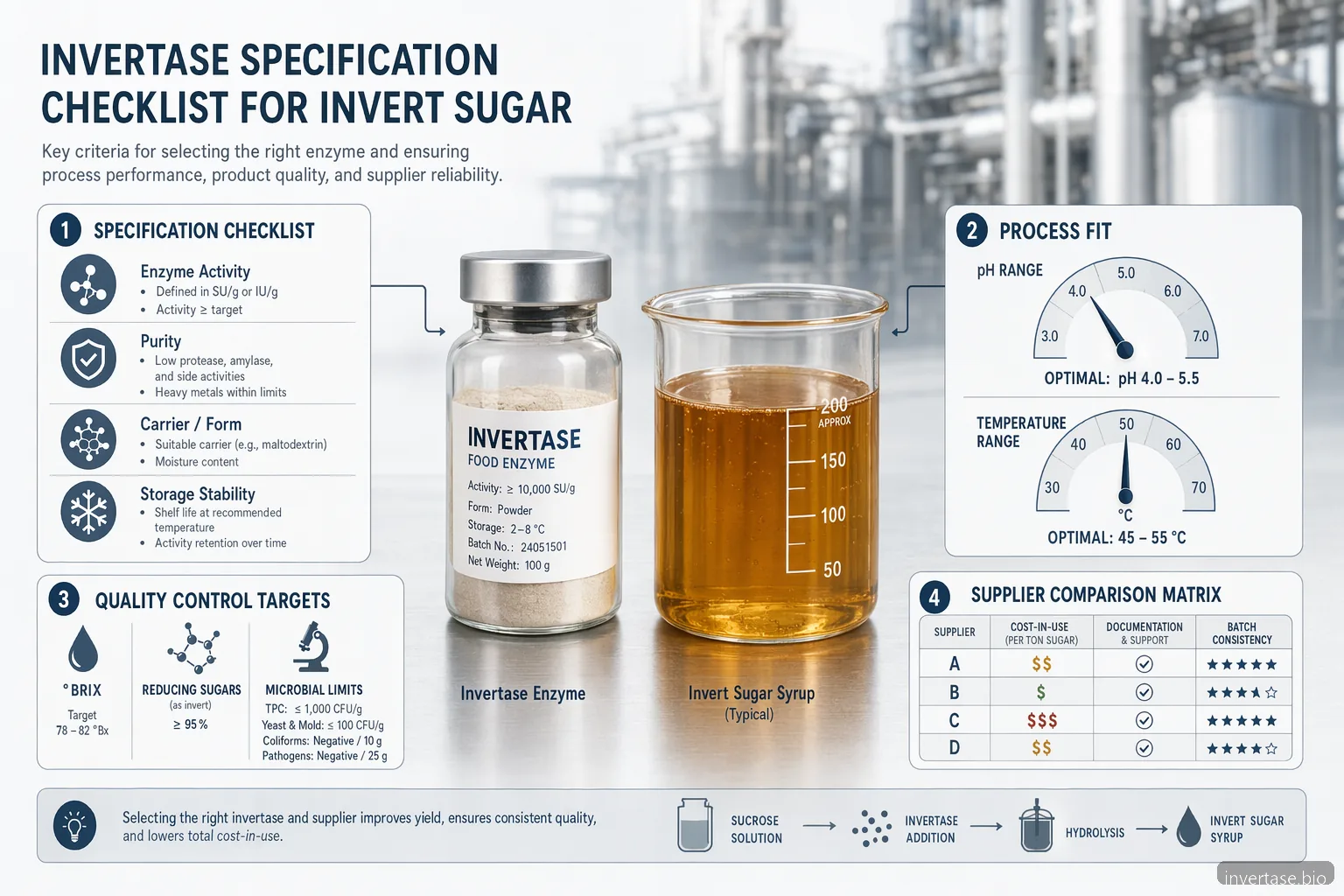
A purchase specification for invertase enzyme for invert sugar should begin with activity definition. Confirm the activity unit, test method, substrate, pH, temperature, and whether the declared value is guaranteed at release or typical. Next, review physical form, solubility, color, odor, carrier or stabilizer system, and recommended storage conditions. For liquid invertase, ask about viscosity, preservative strategy, and stability after opening. For powder or granulated formats, check dispersibility and dust handling requirements. Documentation should include a current COA for each lot, a TDS describing application guidance, and an SDS for safe handling. Depending on your internal standards, you may also require allergen statements, origin information, food-grade suitability statements, and microbiological specifications. Avoid comparing products only by headline activity; two enzymes with similar activity can differ materially in pH tolerance, thermal stability, and cost-in-use.
Confirm activity unit and assay conditions. • Check declared shelf life and storage temperature. • Review carriers, stabilizers, and processing aids. • Require COA, TDS, and SDS before approval.
Process Conditions for Invert Syrup Production
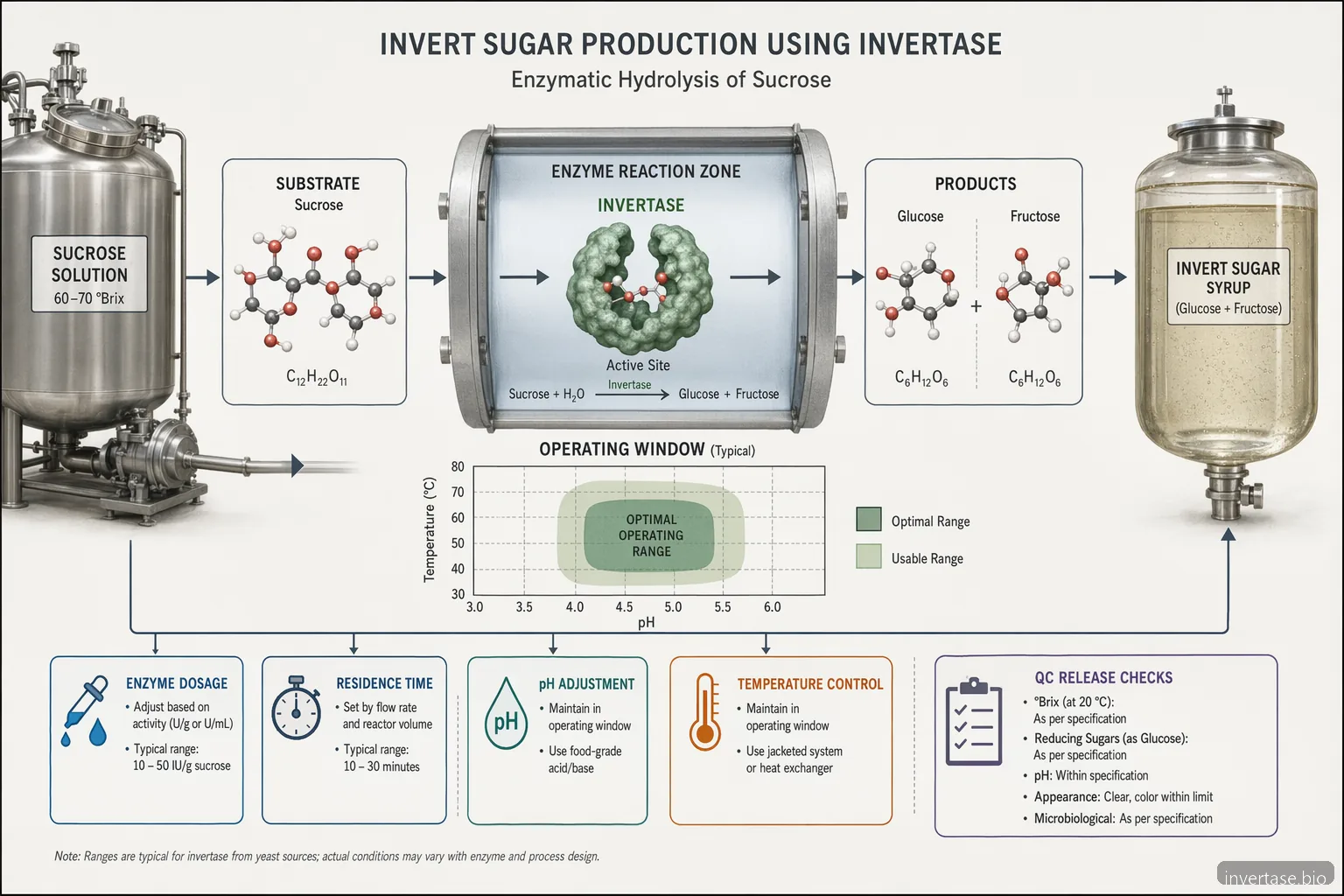
Typical invertase processing for invert syrup uses controlled pH, moderate temperature, and sufficient holding time to reach the desired inversion percentage. Many commercial invertase preparations perform well around pH 4.0–5.5, with practical operating temperatures often in the 45–60°C range, depending on the enzyme source and formulation. Higher temperatures may accelerate reaction initially but can reduce enzyme stability, so time-temperature balance should be validated. Dosage bands are commonly evaluated by trial, for example 0.02–0.20% enzyme preparation by syrup weight, or according to activity units per kilogram of sucrose. Syrup solids can influence viscosity, mass transfer, and reaction speed; pilot batches should reflect plant Brix, raw material quality, and agitation conditions. After reaching target inversion, processors may heat-treat, adjust pH, or otherwise manage residual activity based on the final product requirements and downstream application.
Start trials near pH 4.0–5.5 unless the TDS recommends otherwise. • Evaluate 45–60°C as a practical screening range. • Test dosage by activity units, not only by product weight. • Validate holding time at actual syrup solids and agitation.
QC Checks That Matter in Industrial Buying
Quality control should connect enzyme performance with finished invert sugar specifications. Incoming enzyme checks may include COA review, lot number verification, appearance, packaging integrity, and storage condition confirmation. During production, monitor pH, temperature, Brix or solids, dosage accuracy, mixing time, and residence time. Finished syrup evaluation should include reducing sugar or inversion percentage, residual sucrose, color, sensory suitability where relevant, microbiological status, and stability under intended storage. Methods may include Lane-Eynon, HPLC, polarimetry, or validated internal procedures, depending on plant capability and customer requirements. For confectionery use, crystallization performance and water activity may be as important as chemical inversion. A strong supplier should support method alignment and help interpret deviations without claiming that one specification replaces plant validation. Keep retained samples from pilot and first commercial lots for comparison.
Track reducing sugar, residual sucrose, pH, Brix, and color. • Use validated lab methods suited to your release specification. • Retain samples from pilot and first production lots. • Link enzyme lot data to finished syrup batch records.
Comparing Suppliers for Cost-in-Use
When searching for an invertase supplier for invert sugar, compare total cost-in-use rather than invoice price alone. A higher-activity or more stable enzyme may require lower dosage, shorter holding time, less rework, or fewer process adjustments. Ask suppliers to provide application guidance, sample quantities for pilot validation, lot-to-lot activity expectations, lead time, minimum order quantity, packaging options, and technical response time. Supplier qualification should include documentation review, sample testing, commercial trial approval, and periodic performance checks. If you also need invertase confectionery supplier for invert sugar applications, confirm that the enzyme fits both syrup production and downstream confectionery requirements, such as fondant softening or crystallization control. The best comparison format is a side-by-side trial using identical syrup, pH, temperature, solids, and sampling intervals, followed by calculated enzyme cost per metric ton of finished invert sugar.
Compare dosage required to reach the same inversion target. • Include holding time, energy, labor, and rework in cost-in-use. • Assess technical support and supply reliability. • Qualify suppliers through pilot and commercial validation.
Technical Buying Checklist
Buyer Questions
Invert sugar is a syrup in which sucrose has been hydrolyzed into glucose and fructose. The term inverted sugar refers to the change in optical rotation after hydrolysis. In B2B production, invert sugar is used for functional reasons such as sweetness profile, moisture retention, and crystallization control. The final specification usually defines solids, pH, color, reducing sugars, residual sucrose, and microbiological quality.
Invertase can be attractive when a processor wants milder pH and temperature conditions, fewer neutralization steps, or better control over partial inversion. Acid inversion may still fit some operations where equipment, time, and downstream specifications allow it. The better option depends on syrup solids, target inversion, color limits, processing time, and cost-in-use. A side-by-side pilot trial is the safest comparison.
Dosage depends on enzyme activity, sucrose concentration, pH, temperature, solids, mixing, and target inversion level. A practical screening range may be 0.02–0.20% enzyme preparation by syrup weight, but activity-unit dosing is more accurate. Start with the supplier TDS, then run time-course samples under plant-like conditions. Calculate cost per metric ton of finished invert sugar, not only cost per kilogram of enzyme.
A qualified supplier should provide a COA for the offered lot, TDS with application guidance, SDS for handling, shelf-life and storage information, and traceability details. For industrial approval, ask for samples, recommended trial design, activity assay conditions, microbiological specifications, and packaging options. Supplier qualification should also review lead time, batch consistency, documentation responsiveness, and support during pilot validation.
Sometimes, but the requirements are not always identical. Invertase confectionery use may focus on controlled softening, fondant liquefaction, or crystallization behavior inside a finished product, while invert syrup production focuses on bulk sucrose hydrolysis. If one enzyme is intended for both, validate dosage, pH, temperature, residual activity, sensory impact, and finished product stability separately for each application.
Related Search Themes
what is invert sugar, inverted sugar, invert syrup, invertase supplier for invert sugar, invertase for invert sugar, invertase enzyme supplier for invert sugar
Get a Free Sample & Quote
Share your application, target pH/temperature, and annual demand. We'll recommend the right activity grade and send a free sample with COA/TDS within 24 hours.
Frequently Asked Questions
What is invert sugar in industrial syrup production?
Invert sugar is a syrup in which sucrose has been hydrolyzed into glucose and fructose. The term inverted sugar refers to the change in optical rotation after hydrolysis. In B2B production, invert sugar is used for functional reasons such as sweetness profile, moisture retention, and crystallization control. The final specification usually defines solids, pH, color, reducing sugars, residual sucrose, and microbiological quality.
Is invertase better than acid inversion for invert syrup?
Invertase can be attractive when a processor wants milder pH and temperature conditions, fewer neutralization steps, or better control over partial inversion. Acid inversion may still fit some operations where equipment, time, and downstream specifications allow it. The better option depends on syrup solids, target inversion, color limits, processing time, and cost-in-use. A side-by-side pilot trial is the safest comparison.
How much invertase is needed for invert sugar?
Dosage depends on enzyme activity, sucrose concentration, pH, temperature, solids, mixing, and target inversion level. A practical screening range may be 0.02–0.20% enzyme preparation by syrup weight, but activity-unit dosing is more accurate. Start with the supplier TDS, then run time-course samples under plant-like conditions. Calculate cost per metric ton of finished invert sugar, not only cost per kilogram of enzyme.
What should an invertase enzyme supplier provide before purchase?
A qualified supplier should provide a COA for the offered lot, TDS with application guidance, SDS for handling, shelf-life and storage information, and traceability details. For industrial approval, ask for samples, recommended trial design, activity assay conditions, microbiological specifications, and packaging options. Supplier qualification should also review lead time, batch consistency, documentation responsiveness, and support during pilot validation.
Can the same invertase be used for confectionery and invert sugar?
Sometimes, but the requirements are not always identical. Invertase confectionery use may focus on controlled softening, fondant liquefaction, or crystallization behavior inside a finished product, while invert syrup production focuses on bulk sucrose hydrolysis. If one enzyme is intended for both, validate dosage, pH, temperature, residual activity, sensory impact, and finished product stability separately for each application.
Related: Invertase for Invert Sugar Syrup Production — Enzymatic Sucrose Conversion for Food Manufacturing
Turn This Guide Into a Supplier Brief Request invertase specifications, samples, and pilot support for your invert sugar process. See our application page for Invertase for Invert Sugar Syrup Production — Enzymatic Sucrose Conversion for Food Manufacturing at /applications/invertase-invert-sugar-syrup-production/ for specs, MOQ, and a free 50 g sample.
Get a Free Sample & Quote