Invertase Enzyme Production for Reliable Invert Sugar
Troubleshoot invert sugar with invertase dosage, pH, temperature, QC checks, COA/TDS/SDS review, pilot validation, and cost-in-use guidance.
Industrial invert sugar depends on more than adding enzyme. Control pH, temperature, solids, contact time, and supplier quality to convert sucrose consistently at the lowest practical cost-in-use.
What is invertase enzyme in invert sugar production?
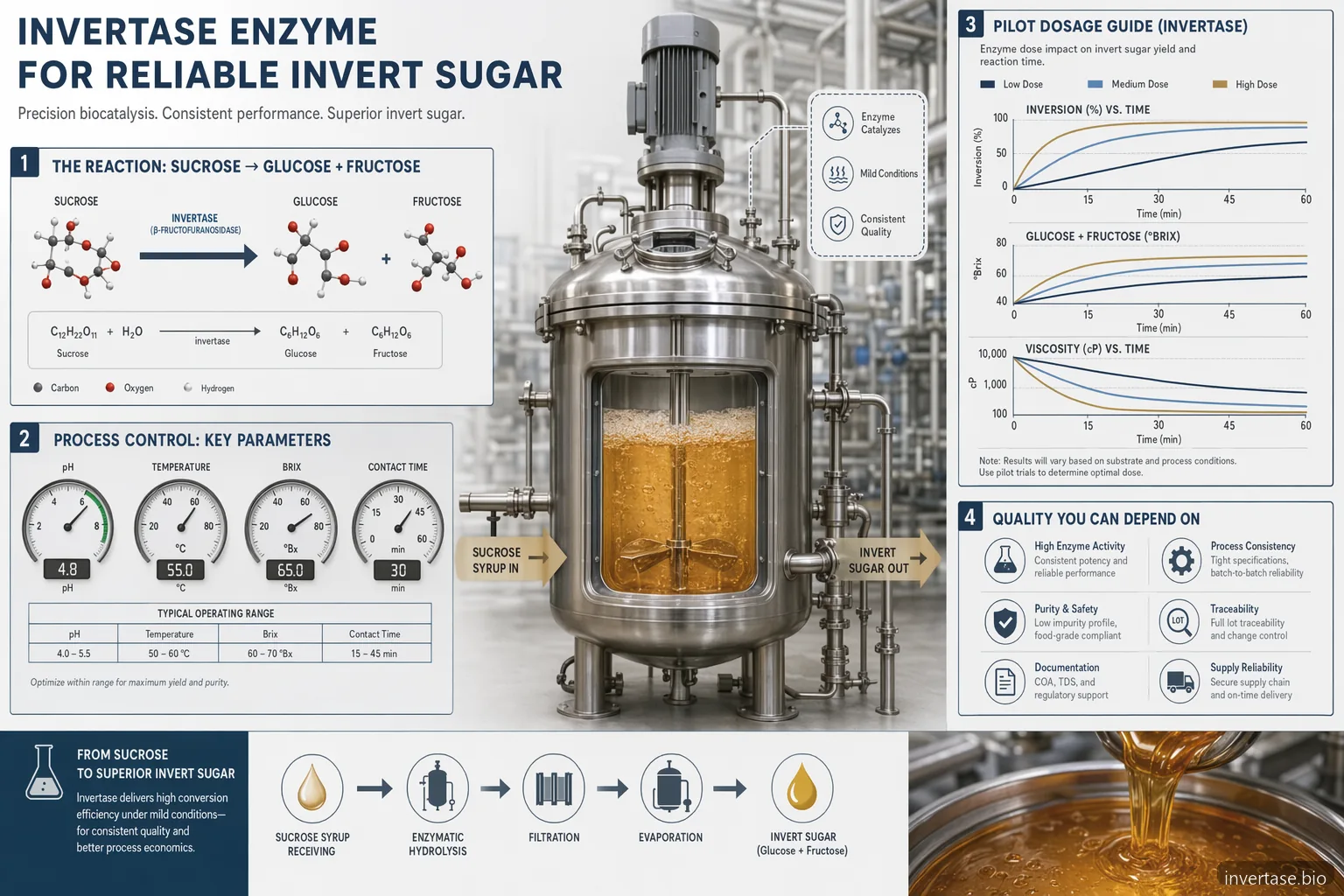
Invertase is an enzyme that catalyzes the hydrolysis of sucrose into glucose and fructose. In industrial language, it is also described as sucrase or β-fructofuranosidase. If a buyer asks, “is invertase an enzyme” or “what is invertase enzyme,” the practical answer is simple: it is a processing aid used to change sugar functionality. The resulting invert sugar is sweeter, more soluble, and less prone to sucrose crystallization than untreated syrup. This is why invertase enzyme production is important for confectionery centers, fondants, cordials, bakery syrups, and selected honey processing operations. The enzyme does not replace process control. It works only when the syrup conditions support activity and mass transfer. High Brix, poor mixing, pH drift, or excessive heat can all reduce conversion speed and create inconsistent final syrup.
Primary substrate: sucrose • Primary products: glucose and fructose • Common application: invert sugar manufacture • Related search term: invertase 10 lettres, often referring to the word itself
Starting dosage bands for pilot production
Invertase dosage should be set by enzyme activity, substrate concentration, process time, and the target degree of inversion. Because commercial preparations differ in potency, a percentage dose is only a screening tool. For lab and pilot work, many syrup processors begin with about 0.02–0.20% w/w of commercial invertase enzyme preparation on sucrose solids, then narrow the range using the supplier’s activity units from the TDS. A faster batch, higher Brix syrup, or lower processing temperature may require more enzyme. A longer hold time or lower Brix may require less. Avoid specifying a plant-wide dose before pilot validation because cost-in-use can change sharply with residence time, heating profile, and conversion target. For purchasing searches such as “invertase enzyme buy,” request a sample with COA, TDS, SDS, recommended dosage, storage conditions, and shelf-life data before quoting annual volume.
Screen: 0.02–0.20% w/w on sucrose solids • Optimize by activity units, not only liquid or powder weight • Confirm target inversion by reducing sugar or chromatographic testing • Calculate cost per tonne of finished syrup
pH, temperature, and Brix troubleshooting
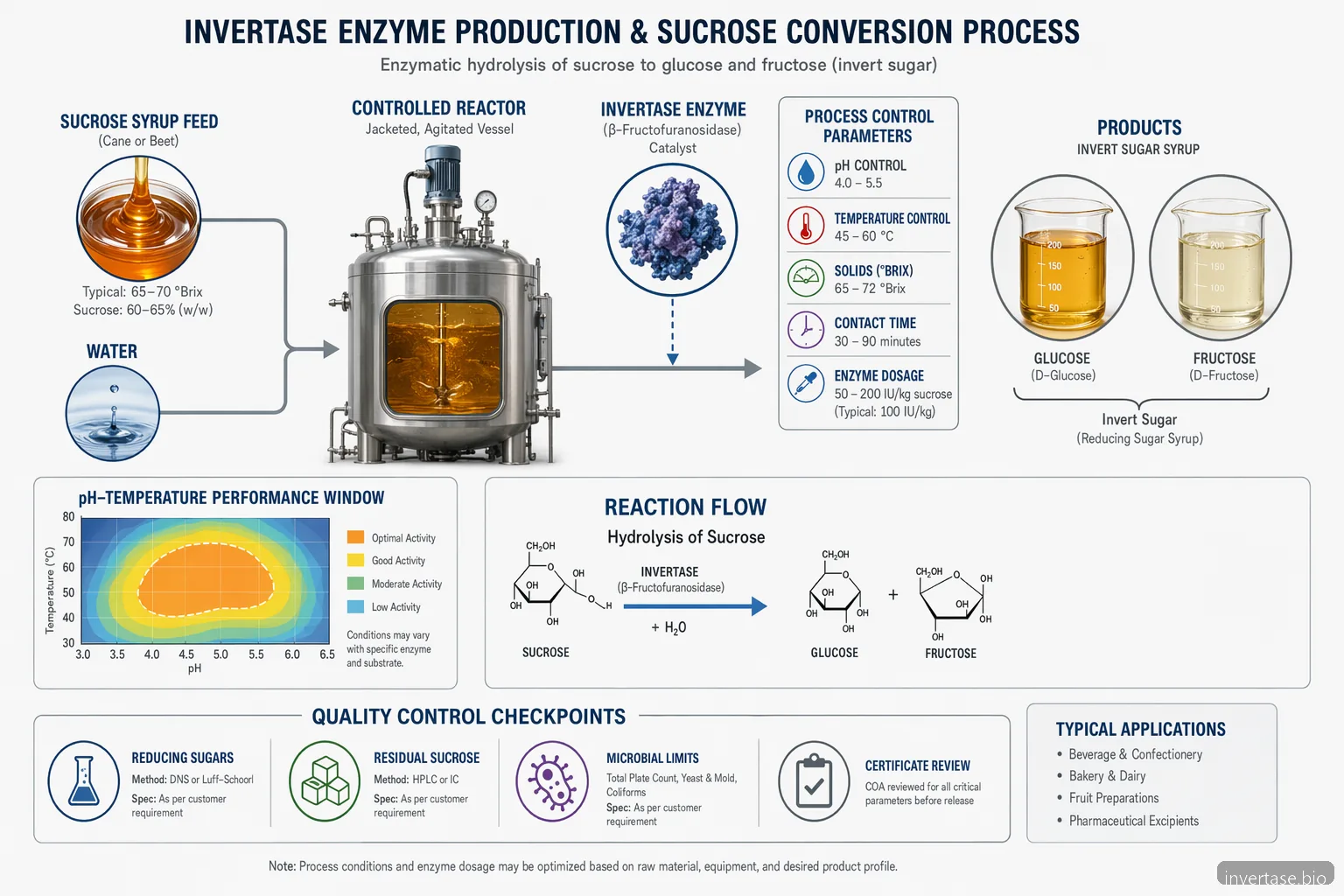
Most food-grade invertase systems perform best in mildly acidic syrup. A practical development window is pH 4.0–5.0, with some products operating acceptably from about pH 3.5–5.5. Temperature trials commonly start at 45–60°C, balancing enzyme rate against thermal inactivation and syrup handling. Higher temperature can speed reaction initially, but it may shorten enzyme life, increase color formation, or raise HMF risk in acidic sugar systems. High Brix improves finished syrup handling but slows enzyme access to sucrose because viscosity rises and water activity falls. If inversion is incomplete, verify calibrated pH readings at process temperature, actual tank temperature, agitation, enzyme age, addition point, and hold time. Do not assume that doubling dose solves every problem; poor mixing or pH drift can make additional enzyme uneconomic.
Typical pH trial window: 4.0–5.0 • Broader development range: about pH 3.5–5.5 • Typical temperature trial window: 45–60°C • Control color and HMF when using heat plus acid
Quality control checks for consistent invert sugar
QC should verify both enzyme performance and finished syrup specification. At minimum, record batch number, enzyme lot, addition rate, syrup solids, pH, temperature profile, agitation, and hold time. Measure Brix before and after processing, but do not use Brix alone as proof of conversion. Use reducing sugar methods for routine plant monitoring and confirm development batches with HPLC, ion chromatography, or another validated glucose, fructose, and sucrose method. Define the target inversion range according to the application: confectionery may need crystallization control, while liquid sweetener applications may prioritize sweetness, viscosity, and stability. If residual activity is not desired, validate a heat step, such as a controlled high-temperature hold, without damaging color or flavor. Retain samples for trend analysis and complaint investigation.
Track residual sucrose, glucose, and fructose • Monitor pH, Brix, color, viscosity, and microbial status • Retain enzyme COA and production batch records • Validate any enzyme inactivation step
Supplier qualification and cost-in-use
A low enzyme price does not guarantee low production cost. Industrial buyers should compare invertase suppliers on activity consistency, recommended process window, documentation, technical support, lead time, packaging, and batch traceability. Request a current COA for each lot, a TDS with activity definition and dosage guidance, and an SDS for handling and storage. If your market requires dietary declarations, ask whether the invertase is vegan, what carrier materials are used, and whether allergens or processing aids are present. Do not rely on broad marketing claims without documentation. Run side-by-side pilot batches using the same sucrose source, Brix, pH, temperature, and endpoint method. Then calculate cost-in-use per tonne of syrup at the required conversion level, including yield losses, rework risk, labor, heating, cooling, and shelf-life performance.
Compare activity per delivered kilogram • Review COA, TDS, SDS, and traceability • Confirm invertase vegan status if required by your customers • Base purchasing on validated cost-in-use
Technical Buying Checklist
Buyer Questions
The invertase enzyme function is to hydrolyze sucrose into glucose and fructose. This produces invert sugar, which is more soluble and less likely to crystallize than sucrose syrup. In B2B production, the key variables are enzyme activity, pH, temperature, Brix, contact time, and mixing. The right conditions depend on the supplier’s TDS and the processor’s target inversion specification.
A practical pilot screening range is about 0.02–0.20% w/w of commercial invertase preparation on sucrose solids. This is not a universal final dose because enzyme activity varies by product. Convert trial results to the supplier’s activity units, then optimize against conversion time, endpoint sucrose, syrup color, labor, energy, and cost-in-use per tonne of finished syrup.
Many industrial invertase processes are developed around pH 4.0–5.0 and 45–60°C. A broader pH screening range of about 3.5–5.5 may be useful depending on the enzyme source and syrup formula. Higher temperatures can increase reaction rate but may also deactivate the enzyme or increase color formation, so pilot validation is essential before scale-up.
Common causes include pH outside the active range, inaccurate tank temperature, insufficient hold time, high Brix viscosity, poor agitation, enzyme added at the wrong step, expired enzyme, or an incorrect dosage basis. Check calibration records, enzyme lot COA, actual process data, and endpoint testing. If needed, run a small factorial pilot varying pH, temperature, dose, and time.
Invertase can be suitable for vegan products, but it is not automatic. Suitability depends on the enzyme source, fermentation media, carriers, and processing aids used by the supplier. Ask for a vegan statement and review the TDS, COA, SDS, and allergen information. For customer-facing claims, rely on supplier documentation and your own regulatory review.
Related Search Themes
invertase, invertase enzyme, invertase 10 lettres, what is invertase enzyme, invertase enzyme function, invertase enzyme buy
Get a Free Sample & Quote
Share your application, target pH/temperature, and annual demand. We'll recommend the right activity grade and send a free sample with COA/TDS within 24 hours.
Frequently Asked Questions
What is invertase enzyme function in invert sugar?
The invertase enzyme function is to hydrolyze sucrose into glucose and fructose. This produces invert sugar, which is more soluble and less likely to crystallize than sucrose syrup. In B2B production, the key variables are enzyme activity, pH, temperature, Brix, contact time, and mixing. The right conditions depend on the supplier’s TDS and the processor’s target inversion specification.
How much invertase should be used for invert sugar production?
A practical pilot screening range is about 0.02–0.20% w/w of commercial invertase preparation on sucrose solids. This is not a universal final dose because enzyme activity varies by product. Convert trial results to the supplier’s activity units, then optimize against conversion time, endpoint sucrose, syrup color, labor, energy, and cost-in-use per tonne of finished syrup.
What pH and temperature are best for invertase?
Many industrial invertase processes are developed around pH 4.0–5.0 and 45–60°C. A broader pH screening range of about 3.5–5.5 may be useful depending on the enzyme source and syrup formula. Higher temperatures can increase reaction rate but may also deactivate the enzyme or increase color formation, so pilot validation is essential before scale-up.
Why is my invert sugar batch not reaching target inversion?
Common causes include pH outside the active range, inaccurate tank temperature, insufficient hold time, high Brix viscosity, poor agitation, enzyme added at the wrong step, expired enzyme, or an incorrect dosage basis. Check calibration records, enzyme lot COA, actual process data, and endpoint testing. If needed, run a small factorial pilot varying pH, temperature, dose, and time.
Is invertase vegan for food manufacturing?
Invertase can be suitable for vegan products, but it is not automatic. Suitability depends on the enzyme source, fermentation media, carriers, and processing aids used by the supplier. Ask for a vegan statement and review the TDS, COA, SDS, and allergen information. For customer-facing claims, rely on supplier documentation and your own regulatory review.
Related: Invertase for Invert Sugar Syrup Production — Enzymatic Sucrose Conversion for Food Manufacturing
Turn This Guide Into a Supplier Brief Request invertase samples, documentation, and pilot dosing support for your invert sugar process. See our application page for Invertase for Invert Sugar Syrup Production — Enzymatic Sucrose Conversion for Food Manufacturing at /applications/invertase-invert-sugar-syrup-production/ for specs, MOQ, and a free 50 g sample.
Get a Free Sample & Quote