How to Use Invertase Powder in Invert Sugar Formulations
Practical guide to invertase powder for invert sugar: dosage, pH, temperature, QC checks, documentation, and supplier qualification.
Invertase powder helps manufacturers convert sucrose into glucose and fructose under controlled process conditions, supporting consistent invert sugar production for confectionery, syrups, and honey-related applications.
What Is Invertase and Why It Matters in Invert Sugar
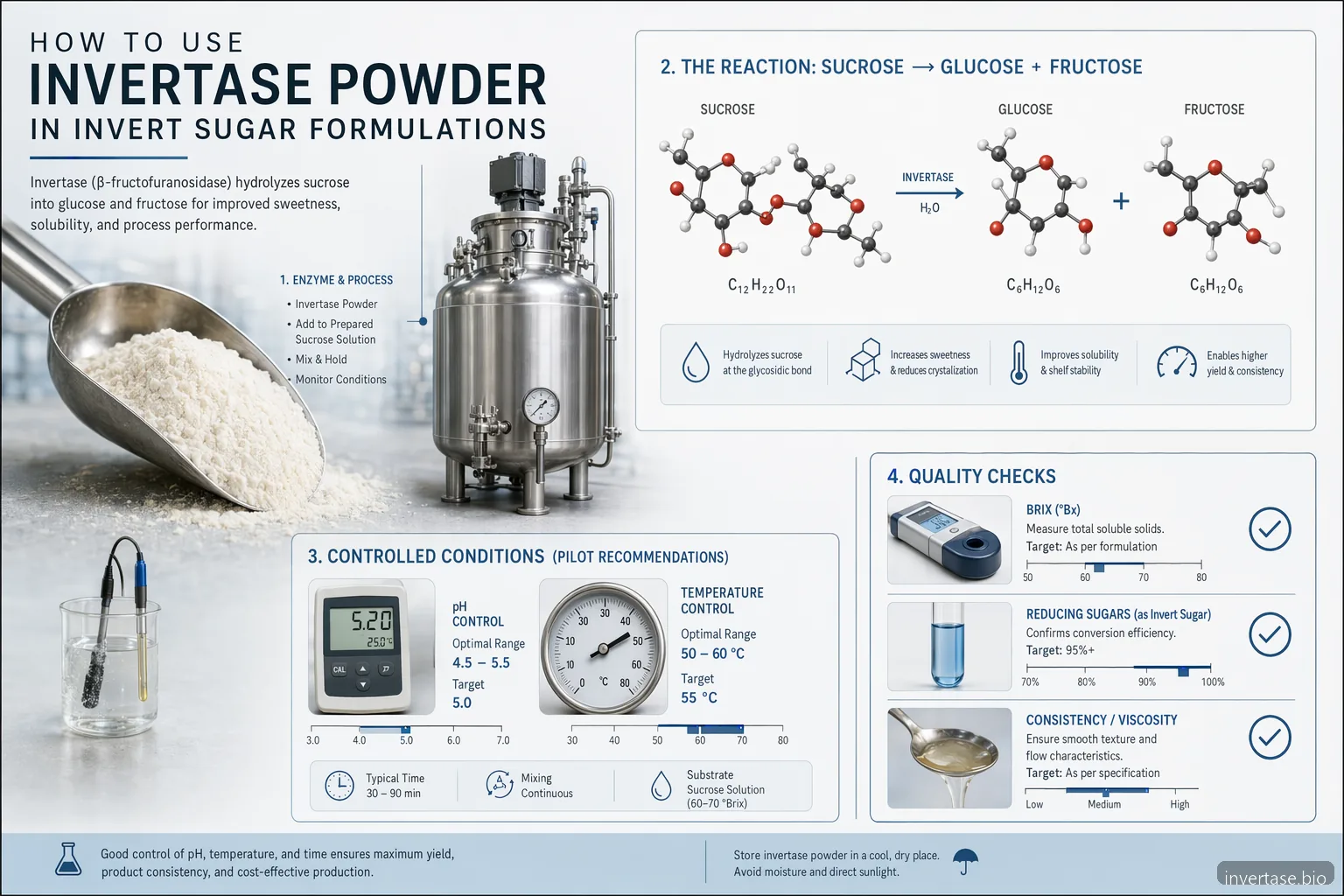
Invertase, also called sucrase in some technical contexts, is an enzyme that catalyzes the hydrolysis of sucrose into glucose and fructose. For industrial buyers asking “what is invertase” or “define invertase,” the practical answer is simple: it is a processing aid used to control sucrose conversion. In invert sugar formulations, this conversion can help reduce crystallization, increase apparent sweetness, improve syrup handling, and support consistent texture in confectionery fillings, fondants, cordials, and related sugar systems. Invertase powder is commonly selected when manufacturers need better storage stability than many liquid formats or easier inventory handling. Performance depends on enzyme activity, substrate concentration, pH, temperature, water activity, and contact time. Because commercial grades vary, formulation teams should validate each invertase enzyme powder against their own sucrose concentration, target Brix, process equipment, and finished-product specifications.
Primary reaction: invertase sucrose hydrolysis into glucose and fructose. • Common use: controlled invert sugar production for industrial food applications. • Key value: crystallization management and consistent syrup functionality.
Starting Process Conditions for Pilot Trials
A safe starting point for pilot work is to dissolve sucrose to the required solids level, adjust pH, add invertase powder, and hold the batch at controlled temperature until the desired degree of inversion is reached. Many invertase enzyme products operate effectively in mildly acidic systems, with initial trials often run around pH 4.5-5.5 and 45-60°C. The exact optimum must come from the supplier’s TDS and your own validation because activity can shift by source, carrier, and formulation matrix. Avoid excessive heat during the active reaction, as high temperatures can denature the enzyme. After reaching target inversion, processors may use heat treatment, pH shift, or downstream cooking steps to stop or limit continued activity. Record time, temperature, pH, Brix, and reducing sugar development at defined intervals to build a reliable scale-up model.
Trial pH: commonly 4.5-5.5, subject to product-specific TDS. • Trial temperature: commonly 45-60°C, avoiding enzyme denaturation. • Track Brix, pH, reducing sugars, and degree of inversion over time. • Confirm enzyme inactivation strategy if residual activity is undesirable.
Dosage Strategy and Cost-in-Use
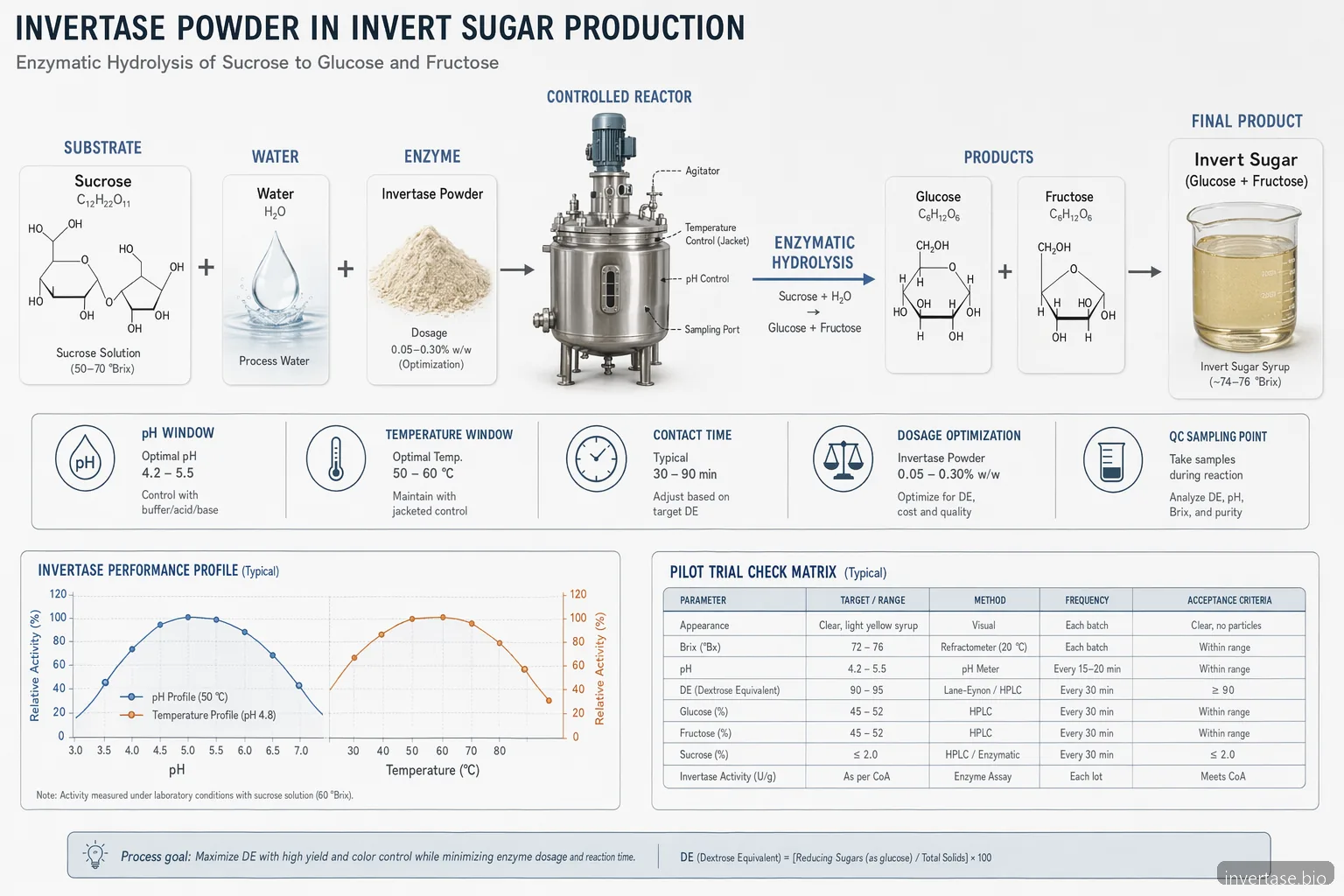
Invertase dosage should be calculated from declared activity, sucrose load, target inversion, batch time, and processing temperature. A practical screening range may compare low, medium, and high enzyme additions under identical conditions, then select the lowest dose that consistently meets the conversion specification within the required production window. Avoid buying only on price per kilogram; cost-in-use is usually more important. A higher-activity invertase powder may reduce dosage, shorten tank residence time, improve throughput, or lower rework risk. Conversely, an inexpensive product with inconsistent activity may increase QC failures. Ask suppliers to state activity units, test method, recommended use range, carrier system, storage conditions, and shelf-life basis. For procurement, compare landed cost, minimum order quantity, lead time, technical support, batch consistency, and documentation quality alongside enzyme performance.
Optimize by activity units, not only kilograms added. • Compare cost per metric ton of finished invert sugar. • Include processing time, failed batches, and rework in cost-in-use. • Validate the lowest effective dose at production-like scale.
Quality Control Checks for Invert Sugar Production
QC should confirm both the raw material suitability and the finished invert sugar specification. For incoming invertase enzyme powder, review the COA against purchase specifications, including activity, appearance, moisture where relevant, microbiological limits if provided, and batch identification. During processing, monitor pH, temperature, Brix, time, and reducing sugar formation. Finished product checks may include degree of inversion, residual sucrose, glucose/fructose profile, color, flavor impact, viscosity, and microbial status depending on the application. Confectionery manufacturers may also run crystallization or storage tests to confirm texture stability. If the invert sugar is used in honey processing or blended sweetener systems, confirm that the enzyme use aligns with applicable labeling and customer requirements. Maintain retain samples and trend data by enzyme lot to detect drift before it affects production.
Incoming checks: COA match, lot number, activity, appearance, storage condition. • In-process checks: pH, temperature, Brix, time, reducing sugars. • Finished checks: inversion level, residual sucrose, color, viscosity, sensory impact. • Use retain samples and lot trend data for supplier performance review.
Supplier Qualification for B2B Buyers
A qualified invertase supplier should support both purchasing and technical teams. Before approval, request a current COA, TDS, SDS, activity assay description, recommended storage conditions, shelf-life statement, allergen or dietary suitability information such as invertase vegan status when required, and country-of-origin or traceability details. Do not rely on generic claims; confirm every requirement against documents and customer specifications. If buyers search terms such as “invertase 10 lettres,” they may be looking for terminology rather than sourcing, but industrial procurement should focus on function, documentation, and batch reliability. Run a pilot validation using the supplier’s retained sample or commercial sample, then confirm performance with at least one production-scale batch. Establish change-notification expectations for enzyme source, carrier, activity method, packaging, and manufacturing site before routine ordering.
Request COA, TDS, SDS, activity method, and traceability documentation. • Confirm vegan, allergen, and labeling requirements from supplier documents. • Require pilot validation before full-scale adoption. • Agree on change notification and lot-to-lot consistency expectations.
Technical Buying Checklist
Buyer Questions
Invertase powder is used to convert sucrose into glucose and fructose under controlled processing conditions. In invert sugar manufacturing, this helps manage crystallization, sweetness profile, solubility, and syrup consistency. Industrial users typically evaluate invertase by activity, pH and temperature profile, dosage efficiency, documentation quality, and performance in the specific sugar concentration used in their process.
Many invertase enzyme powders are first screened around pH 4.5-5.5 and 45-60°C, but the correct range depends on the enzyme source and formulation matrix. Always confirm the supplier’s TDS and run pilot trials. Measure pH, Brix, temperature, reducing sugar formation, and degree of inversion over time before approving a production set point.
Start with a dosage ladder based on the supplier’s declared activity and recommended use range. Run low, medium, and high additions at the same sucrose concentration, pH, temperature, and hold time. Select the lowest dose that reliably reaches your target inversion within the required production window, then confirm cost-in-use and repeatability at scale.
Invertase vegan status depends on the production organism, processing aids, carriers, and facility controls. Buyers should not assume suitability from the enzyme name alone. Request written supplier documentation covering source, carrier, allergen status, and any dietary suitability statements required by your customer or market. Confirm that these documents match your finished-product labeling and procurement standards.
For supplier qualification, request a COA for the specific batch, TDS, SDS, activity assay method, recommended storage conditions, shelf-life basis, allergen information, traceability details, and change-notification policy. For higher-volume purchasing, also review packaging format, lead time, minimum order quantity, technical support availability, and consistency data from pilot or production trials.
Related Search Themes
invertase, invertase 10 lettres, invertase vegan, invertase enzyme powder, invertase enzyme, what is invertase
Get a Free Sample & Quote
Share your application, target pH/temperature, and annual demand. We'll recommend the right activity grade and send a free sample with COA/TDS within 24 hours.
Frequently Asked Questions
What is invertase powder used for in invert sugar?
Invertase powder is used to convert sucrose into glucose and fructose under controlled processing conditions. In invert sugar manufacturing, this helps manage crystallization, sweetness profile, solubility, and syrup consistency. Industrial users typically evaluate invertase by activity, pH and temperature profile, dosage efficiency, documentation quality, and performance in the specific sugar concentration used in their process.
What pH and temperature should I use for invertase sucrose conversion?
Many invertase enzyme powders are first screened around pH 4.5-5.5 and 45-60°C, but the correct range depends on the enzyme source and formulation matrix. Always confirm the supplier’s TDS and run pilot trials. Measure pH, Brix, temperature, reducing sugar formation, and degree of inversion over time before approving a production set point.
How do I choose the right dosage of invertase enzyme powder?
Start with a dosage ladder based on the supplier’s declared activity and recommended use range. Run low, medium, and high additions at the same sucrose concentration, pH, temperature, and hold time. Select the lowest dose that reliably reaches your target inversion within the required production window, then confirm cost-in-use and repeatability at scale.
Is invertase vegan?
Invertase vegan status depends on the production organism, processing aids, carriers, and facility controls. Buyers should not assume suitability from the enzyme name alone. Request written supplier documentation covering source, carrier, allergen status, and any dietary suitability statements required by your customer or market. Confirm that these documents match your finished-product labeling and procurement standards.
What documents should an industrial invertase buyer request?
For supplier qualification, request a COA for the specific batch, TDS, SDS, activity assay method, recommended storage conditions, shelf-life basis, allergen information, traceability details, and change-notification policy. For higher-volume purchasing, also review packaging format, lead time, minimum order quantity, technical support availability, and consistency data from pilot or production trials.
Related: Invertase for sugar inversion and liquid-centre production
Turn This Guide Into a Supplier Brief Request invertase powder specifications, samples, and pilot-trial support for your invert sugar formulation. See our application page for Invertase for sugar inversion and liquid-centre production at /applications/invertase-buy-hong-kong/ for specs, MOQ, and a free 50 g sample.
Get a Free Sample & Quote