Invertase for Inverted Sugar Production
Produce inverted sugar with invertase enzyme: process conditions, dosage, QC checks, supplier qualification, COA/TDS/SDS, and pilot guidance.
Use invertase to convert sucrose into glucose and fructose for controlled invert sugar syrup production in confectionery, bakery, beverage, and honey-processing applications.
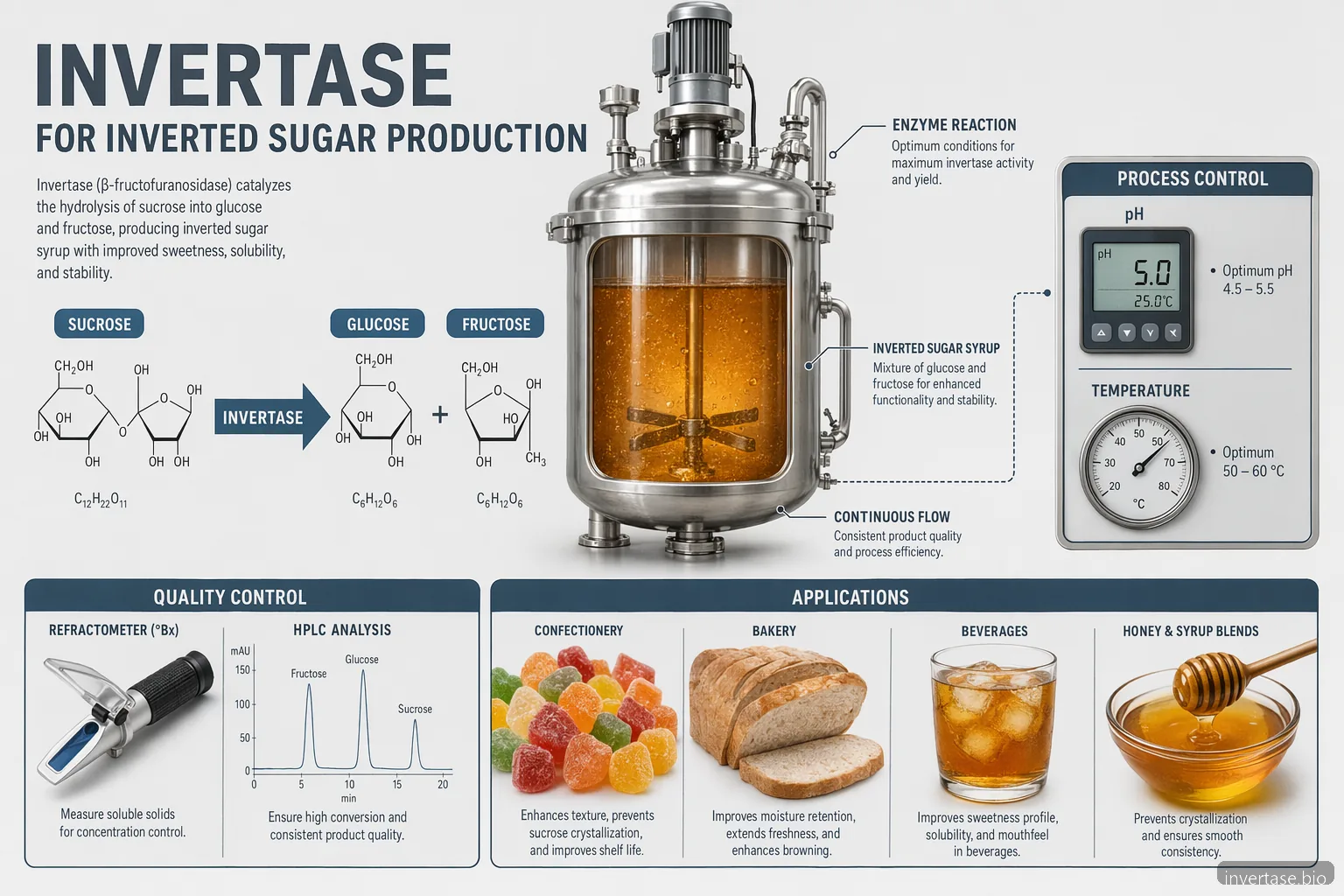
What Is Inverted Sugar and Why Use Invertase?
Inverted sugar, also called invert sugar, is a syrup produced when sucrose is hydrolyzed into glucose and fructose. For buyers asking what is invert sugar, the practical answer is a sweetener system with higher reducing sugar content, good solubility, and useful control over crystallization. Invertase enzyme, also known as sucrase, provides a controlled biological route for this conversion under relatively mild processing conditions. Compared with acid inversion, invertase for invert sugar can help reduce harsh thermal treatment and may support cleaner flavor profiles when the process is properly validated. In confectionery, invertase sugar syrups are commonly evaluated for fondants, creams, soft centers, fillings, and humectancy management. Invertase is also relevant where honey-like sweetness profiles or controlled sucrose reduction are required. The right specification depends on target inversion, syrup solids, process time, and downstream heat treatment.
Converts sucrose into glucose and fructose • Supports crystallization control in confectionery systems • Works under mild acidic process conditions • Useful for invert sugar syrup standardization
Recommended Process Conditions for Invert Sugar
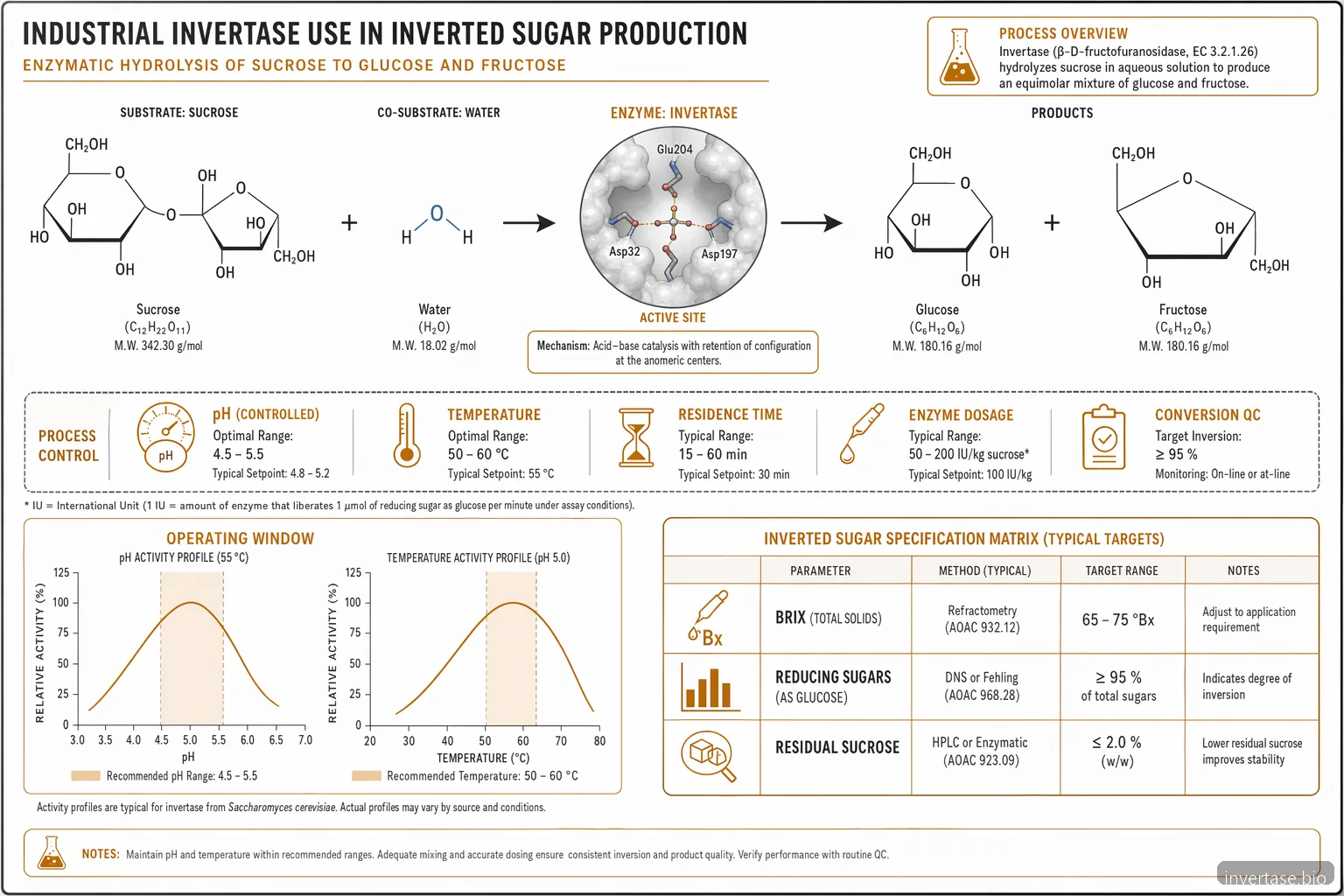
A practical starting point for invertase enzyme for invert sugar is a sucrose syrup adjusted to about pH 4.0 to 5.5, with many processes screening pH 4.5 to 5.0 during pilot work. Temperature is often evaluated between 45 and 60°C, depending on the enzyme source, syrup solids, and residence time. Higher solids, such as 60 to 70°Brix, improve process efficiency but increase viscosity and may slow mass transfer, so agitation and temperature uniformity matter. Dosage is best set by enzyme activity, not only by weight. As an initial screening band, processors may test approximately 0.02 to 0.20% enzyme preparation by syrup weight, or an equivalent activity-unit dosage supplied on the TDS. Reaction time can range from a few hours to overnight. Stop the reaction by heat inactivation or by moving the syrup into a downstream step that validates enzyme deactivation.
Screen pH 4.0 to 5.5 • Evaluate 45 to 60°C where suitable for the enzyme grade • Validate dosage by activity units and target conversion • Confirm heat inactivation under plant conditions
QC Checks for Consistent Conversion
Quality control should confirm that inverted sugar production meets the agreed sucrose conversion target without creating avoidable color, flavor, or microbiological issues. Common in-process checks include pH, temperature, Brix, viscosity, and reaction time. Conversion can be monitored by reducing sugar methods, residual sucrose analysis, or HPLC when tighter control is needed. For confectionery and beverage applications, teams often track color, ash, turbidity, flavor, and microbial limits based on the finished product specification. If the syrup will be stored, assess water activity, preservative strategy, packaging hygiene, and hold temperature. A robust QC plan should also verify enzyme lot consistency through the certificate of analysis and incoming inspection. When comparing an invertase supplier for invert sugar, request test methods or activity definitions so plant trials can be reproduced across lots and production sites.
Measure Brix, pH, temperature, and hold time • Track reducing sugars and residual sucrose • Use HPLC for tighter conversion specifications • Review COA values against internal acceptance criteria
Dosage, Cost-in-Use, and Pilot Validation
The lowest purchase price per kilogram is not always the lowest cost-in-use. A concentrated invertase may cost more per unit weight but require less addition, shorter hold time, lower energy input, or fewer rework batches. Buyers should compare enzyme activity, recommended dosage, conversion curve, storage stability, packaging size, and ease of dosing. Pilot validation should test at least three dosage levels, two temperatures, and the actual syrup Brix used in production. Measure conversion over time and identify the point where additional enzyme no longer delivers economic benefit. For scale-up, confirm mixing, heat-up time, cooling time, and enzyme distribution in the tank. Include a retained sample from each trial and document sensory, analytical, and process results. These steps help procurement, R&D, and production align on a repeatable invertase enzyme supplier for invert sugar.
Compare cost per converted sucrose unit • Run dose-response trials before commercial purchase • Validate at production Brix and mixing conditions • Document conversion curves for scale-up
Supplier Qualification and Documentation
Industrial enzyme purchasing should include technical and quality documentation before approval. Request a TDS for activity definition, recommended pH and temperature, appearance, solubility, storage, shelf life, and dosage guidance. The COA should identify the lot, activity result, manufacturing or release date, and relevant quality parameters. The SDS should be reviewed by EHS teams for handling, spill response, PPE, and storage requirements. If the enzyme will be used in food processing, confirm that the grade, intended use, and regulatory status are appropriate for your market with your internal regulatory team. Avoid relying on vague claims or unsupported certifications. A qualified invertase enzyme supplier for invert sugar should support pilot batches, provide consistent technical communication, and help interpret trial results without overstating performance beyond the validated process window.
Request COA, TDS, and SDS before approval • Confirm activity definition and lot traceability • Review food-use suitability for target markets • Assess technical support and response time
Application Fit: Confectionery, Syrups, and Honey Processing
Invertase for inverted sugar is especially relevant where sucrose crystallization, sweetness profile, or moisture behavior must be controlled. In confectionery, it can be used to prepare invert sugar syrups or to support softening effects in certain filled products when formulation and heat treatment allow enzyme activity. In syrup production, invertase can provide a measured route to partial or high inversion depending on the specification. Honey processing teams may evaluate invertase where sucrose reduction, flavor protection, or lower-temperature processing is important, while still meeting local compositional and labeling rules. Some buyers search niche phrases such as pepino sugar invertase, but the key technical issue remains the same: matching invertase activity to sucrose substrate, pH, temperature, and target conversion. For any application, commercial success depends on validated process control rather than generic dosage claims.
Useful for confectionery fillings and invert syrup systems • Supports partial or high sucrose inversion targets • Can be evaluated for honey-processing workflows • Requires application-specific validation
Technical Buying Checklist
Buyer Questions
Invert sugar is a mixture of glucose and fructose produced by hydrolyzing sucrose. In industrial processing, it is usually made as a controlled syrup rather than a dry ingredient. The target level of inversion depends on the application, such as confectionery texture, syrup sweetness, crystallization control, or moisture management. Invertase provides an enzymatic route to this conversion under mild acidic conditions.
Dosage depends on enzyme activity, sucrose concentration, pH, temperature, hold time, and target conversion. A practical pilot range is often about 0.02 to 0.20% enzyme preparation by syrup weight, but activity-unit dosing from the TDS is more reliable. Run dose-response trials and measure residual sucrose or reducing sugars to identify the most economical addition rate.
Invertase and acid inversion are different process tools. Invertase can operate under milder pH and temperature conditions, which may be useful where flavor, color, or controlled conversion are priorities. Acid inversion may be faster or simpler in some plants. The best choice depends on product specification, equipment, processing time, regulatory review, and total cost-in-use.
A qualified supplier should provide a technical data sheet with activity definition, recommended conditions, dosage guidance, storage, and shelf life. They should also provide a certificate of analysis for each lot and a safety data sheet for handling review. For food applications, your regulatory team should confirm that the grade and intended use fit the target market.
Start with bench trials to define pH, temperature, Brix, dosage, and conversion time. Move to pilot batches using production-like mixing, heat-up, and cooling profiles. Track Brix, pH, residual sucrose, reducing sugars, color, flavor, and microbial status. Confirm enzyme inactivation and storage stability. Scale only after the process meets specification consistently and cost-in-use is acceptable.
Get a Free Sample & Quote
Share your application, target pH/temperature, and annual demand. We'll recommend the right activity grade and send a free sample with COA/TDS within 24 hours.
Frequently Asked Questions
What is invert sugar in industrial processing?
Invert sugar is a mixture of glucose and fructose produced by hydrolyzing sucrose. In industrial processing, it is usually made as a controlled syrup rather than a dry ingredient. The target level of inversion depends on the application, such as confectionery texture, syrup sweetness, crystallization control, or moisture management. Invertase provides an enzymatic route to this conversion under mild acidic conditions.
How much invertase is needed for invert sugar production?
Dosage depends on enzyme activity, sucrose concentration, pH, temperature, hold time, and target conversion. A practical pilot range is often about 0.02 to 0.20% enzyme preparation by syrup weight, but activity-unit dosing from the TDS is more reliable. Run dose-response trials and measure residual sucrose or reducing sugars to identify the most economical addition rate.
Is invertase better than acid inversion?
Invertase and acid inversion are different process tools. Invertase can operate under milder pH and temperature conditions, which may be useful where flavor, color, or controlled conversion are priorities. Acid inversion may be faster or simpler in some plants. The best choice depends on product specification, equipment, processing time, regulatory review, and total cost-in-use.
What documents should an invertase supplier provide?
A qualified supplier should provide a technical data sheet with activity definition, recommended conditions, dosage guidance, storage, and shelf life. They should also provide a certificate of analysis for each lot and a safety data sheet for handling review. For food applications, your regulatory team should confirm that the grade and intended use fit the target market.
How do we validate invertase for commercial scale-up?
Start with bench trials to define pH, temperature, Brix, dosage, and conversion time. Move to pilot batches using production-like mixing, heat-up, and cooling profiles. Track Brix, pH, residual sucrose, reducing sugars, color, flavor, and microbial status. Confirm enzyme inactivation and storage stability. Scale only after the process meets specification consistently and cost-in-use is acceptable.
Related: Invertase for Invert Sugar Syrup Production — Enzymatic Sucrose Conversion for Food Manufacturing
Turn This Guide Into a Supplier Brief Request invertase TDS, COA, SDS, and pilot support for your invert sugar process. See our application page for Invertase for Invert Sugar Syrup Production — Enzymatic Sucrose Conversion for Food Manufacturing at /applications/invertase-invert-sugar-syrup-production/ for specs, MOQ, and a free 50 g sample.
Get a Free Sample & Quote