What Is Invert Sugar: How to Use Invertase in Invert Sugar Formulations
Learn what invert sugar is and how B2B formulators use invertase enzyme for invert sugar, invert syrup, QC, dosing, and supplier qualification.
Invert sugar is a functional sweetener made by splitting sucrose into glucose and fructose. For industrial producers, invertase offers a controlled enzymatic route to invert syrup with defined sweetness, crystallization control, and processing consistency.
What Is Invert Sugar?
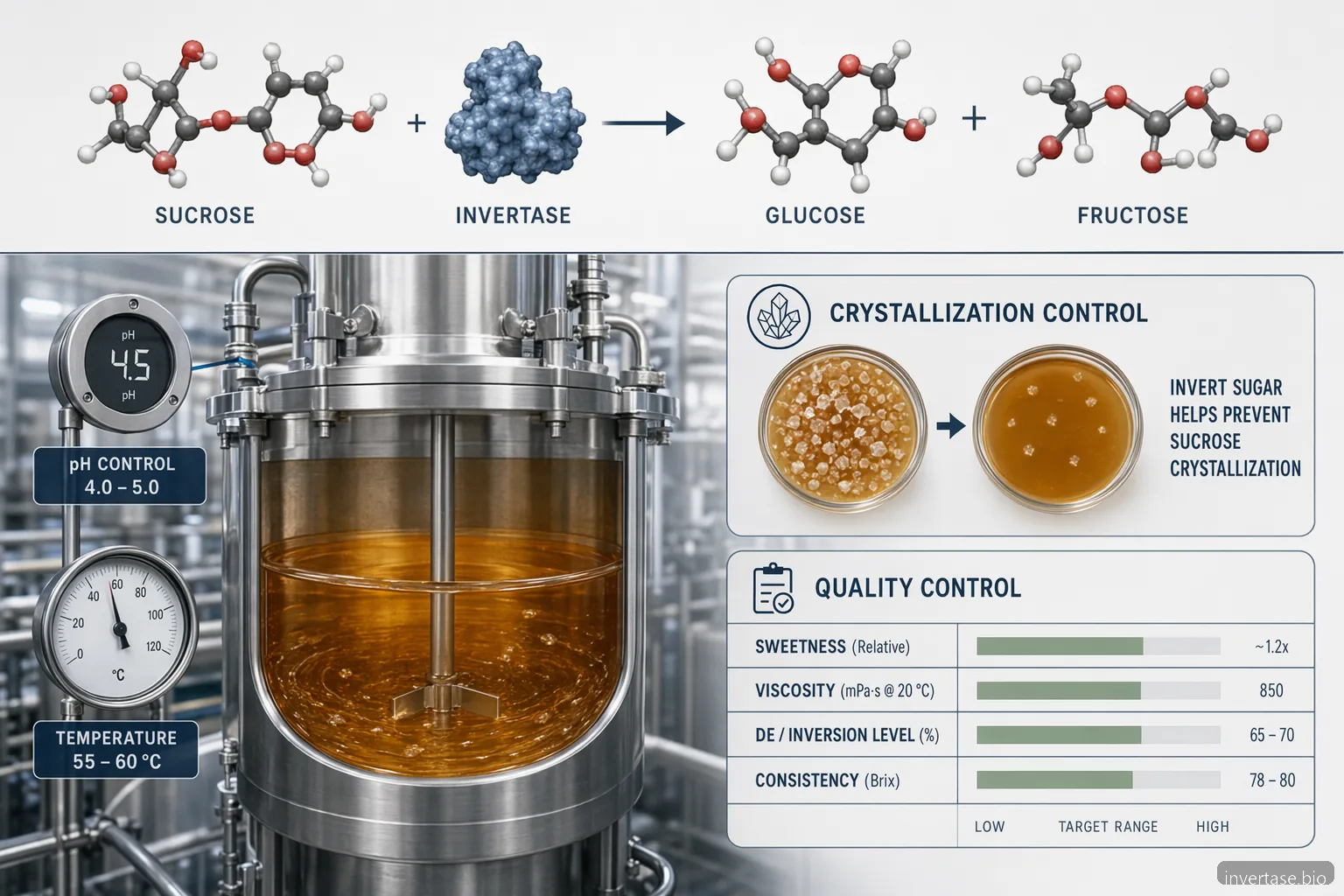
Invert sugar is a sweetener produced when sucrose is hydrolyzed into its two monosaccharides: glucose and fructose. The term "inverted sugar" comes from the change in optical rotation that occurs after sucrose is split. In industrial use, invert sugar may be supplied as an invert syrup or produced in-house from refined sucrose solution. It is valued in confectionery, bakery fillings, beverages, honey processing, and specialty syrups because it can reduce sucrose crystallization, increase humectancy, and adjust perceived sweetness. The final formulation is not a single fixed composition; it depends on the degree of inversion, solids level, pH, and thermal history. For B2B formulators asking what is invert sugar, the practical answer is a controlled glucose-fructose syrup system designed to meet a specific functional target, such as softness, shelf stability, pumpability, or anti-graining performance.
Main components: glucose, fructose, residual sucrose, and water • Common format: liquid invert syrup at defined °Brix • Functional role: sweetness, humectancy, and crystallization control
Why Use Invertase for Invert Sugar Production?
Invertase enzyme for invert sugar provides a mild, targeted alternative to acid hydrolysis. The enzyme, also known as sucrase, catalyzes the conversion of sucrose into glucose and fructose without requiring strong acid conditions. This can help formulators manage flavor, color development, ash contribution, and downstream neutralization requirements. Enzymatic inversion is especially useful when the process needs a defined partial inversion rather than maximum conversion. In confectionery and syrup production, invertase can be added to a prepared sucrose solution and held under controlled conditions until the target reducing sugar or sucrose profile is reached. The process is still formulation-specific: high solids increase viscosity and may slow reaction rates, while pH and temperature strongly affect activity. A qualified invertase supplier for invert sugar should help translate enzyme activity units into practical dosage, residence time, and cost-in-use for the buyer's syrup system.
Milder processing than strong acid inversion • Suitable for partial or high inversion targets • Supports controlled invert syrup formulation • Requires activity-based dosing, not only weight-based dosing
Typical Process Conditions for Invertase in Invert Syrup
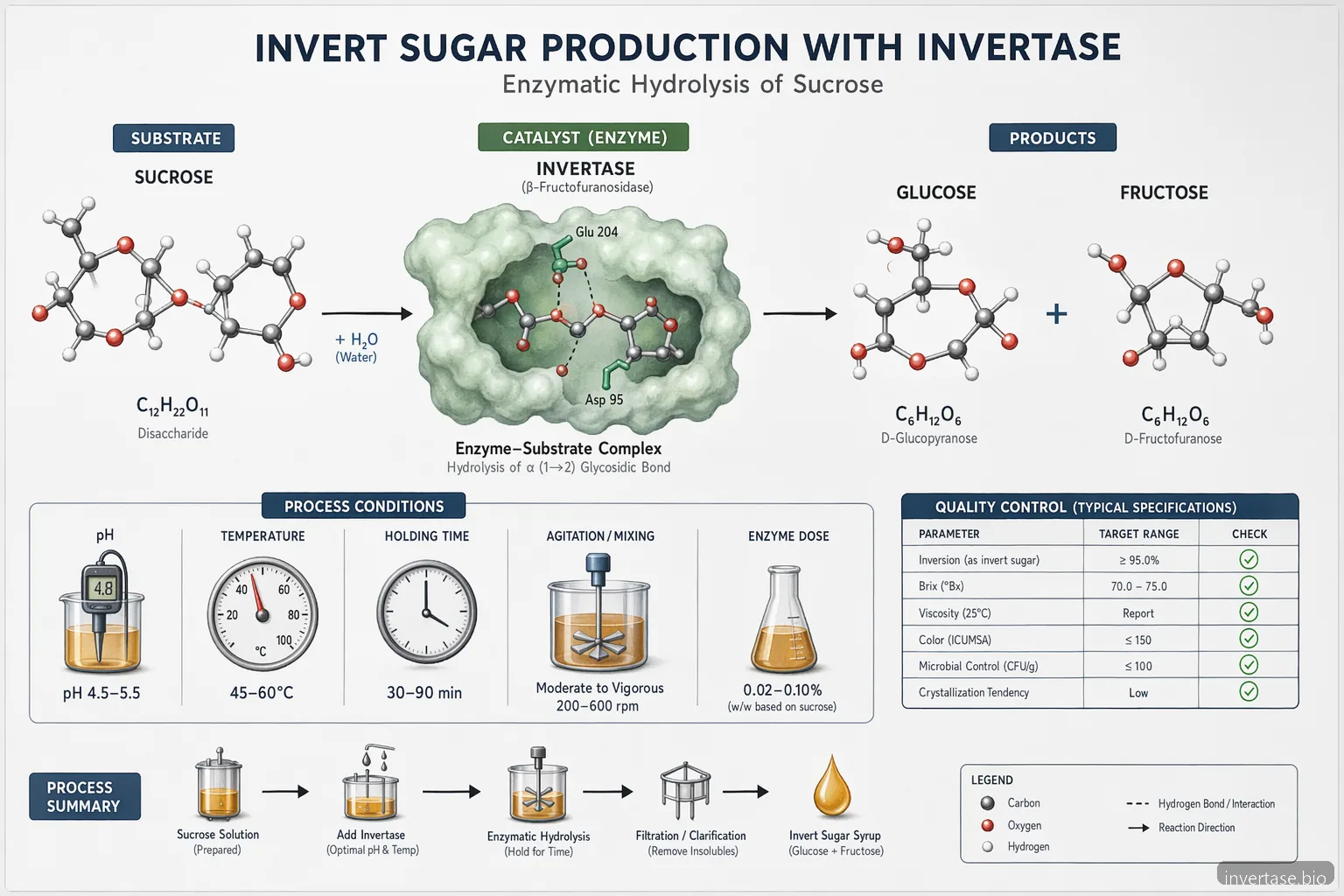
A practical invertase for invert sugar process commonly begins with a clean sucrose solution adjusted to the desired solids level. Many producers evaluate 50 to 70 °Brix systems, recognizing that higher °Brix improves finished syrup concentration but reduces mass transfer and enzyme mobility. Typical enzyme trials are run around pH 4.0 to 5.5 and 45 to 60 °C, depending on the invertase source and product TDS. Lower temperatures may work but require longer hold times; excessive heat can reduce enzyme activity. Dosage is best set by activity units, but early screening often uses a supplier-recommended band such as 0.02% to 0.20% enzyme preparation by syrup weight, then refines based on conversion kinetics. Hold time may range from under one hour to several hours. After reaching target inversion, processors usually heat-treat, adjust pH if needed, and concentrate or cool for storage.
Initial trial pH: often 4.0 to 5.5 • Initial trial temperature: often 45 to 60 °C • Screening dosage: commonly 0.02% to 0.20% enzyme preparation by syrup weight • Confirm exact conditions against the supplier TDS and pilot data
Formulation Targets and Quality Control Checks
Invert sugar formulation should start with the performance required in the finished application. A confectionery syrup may need anti-crystallization and softness, while a honey processing application may prioritize controlled sucrose reduction and minimal sensory change. QC should therefore measure both reaction progress and finished syrup suitability. Common checks include pH, °Brix, reducing sugars, residual sucrose, glucose-fructose ratio, viscosity, color, conductivity or ash where relevant, and microbiological status. HPLC is often used when precise carbohydrate profiling is needed; rapid reducing sugar methods may be suitable for routine process control after validation. Finished invert syrup should also be assessed under storage and use conditions, including crystallization tendency, pumpability, and compatibility with acids, flavors, colors, or other sweeteners. The best formulation endpoint is not always full inversion; many products perform better with a defined partial inversion level that balances sweetness, water activity, viscosity, and cost.
Track residual sucrose and reducing sugar development • Verify °Brix, pH, viscosity, color, and microbiology • Use HPLC for precise carbohydrate profile when required • Validate storage stability and anti-crystallization performance
How to Qualify an Invertase Supplier for Invert Sugar
Selecting an invertase enzyme supplier for invert sugar should be based on technical fit, documentation, consistency, and commercial reliability. Request a current COA for batch-specific activity and quality attributes, a TDS for application conditions and handling guidance, and an SDS for safe storage and use. Ask whether the supplier can support pilot validation, including dosage-response testing, pH and temperature mapping, and cost-in-use modeling. For industrial purchasing, the lowest enzyme price per kilogram may not be the lowest process cost if activity is low, conversion is slow, or more rework is required. Supplier qualification should also review lead time, packaging, shelf life, storage temperature, allergen or processing aid declarations where applicable, and change notification practices. A strong invertase confectionery supplier for invert sugar will help align enzyme performance with your target syrup specification, production schedule, and quality system.
Request COA, TDS, SDS, and batch activity information • Run pilot validation before plant-scale adoption • Compare suppliers by cost-in-use, not only unit price • Confirm storage, shelf life, packaging, and change controls
Technical Buying Checklist
Buyer Questions
Invert sugar is a syrup or sweetener system made by hydrolyzing sucrose into glucose and fructose. In industry, it is specified by solids, pH, color, residual sucrose, reducing sugar level, viscosity, and microbiological status. It is used when formulators need controlled sweetness, humectancy, reduced sucrose crystallization, or a defined carbohydrate profile in confectionery, syrups, honey processing, and related applications.
Invertase and sucrase are commonly used names for enzymes that hydrolyze sucrose into glucose and fructose. In purchasing and formulation, the key issue is not only the name but the enzyme preparation's activity, source, operating pH, temperature stability, purity profile, and documentation. Buyers should review the TDS and COA to confirm the enzyme is suitable for their invert sugar process.
The required invertase dosage depends on enzyme activity, sucrose concentration, °Brix, pH, temperature, desired inversion level, and available reaction time. As a starting laboratory screen, some formulators evaluate about 0.02% to 0.20% enzyme preparation by syrup weight, then convert results into activity-based dosing. Final dosage should be validated in pilot trials and compared by cost-in-use.
Many invertase trials for invert syrup start around pH 4.0 to 5.5 and 45 to 60 °C, but the correct range depends on the specific enzyme product. Higher temperatures may accelerate reaction until thermal deactivation becomes significant. High °Brix syrup can also slow conversion. Always confirm the supplier's TDS, then validate with your sucrose concentration, equipment, and target inversion level.
Evaluate an invertase supplier for invert sugar using both technical and commercial criteria. Request COA, TDS, SDS, batch activity, storage guidance, shelf life, and food-use documentation where applicable. Run pilot validation to compare conversion rate, finished syrup quality, and cost-in-use. Also review lead time, packaging, change notification, batch consistency, and technical support for scale-up and troubleshooting.
Get a Free Sample & Quote
Share your application, target pH/temperature, and annual demand. We'll recommend the right activity grade and send a free sample with COA/TDS within 24 hours.
Frequently Asked Questions
What is invert sugar in industrial formulation?
Invert sugar is a syrup or sweetener system made by hydrolyzing sucrose into glucose and fructose. In industry, it is specified by solids, pH, color, residual sucrose, reducing sugar level, viscosity, and microbiological status. It is used when formulators need controlled sweetness, humectancy, reduced sucrose crystallization, or a defined carbohydrate profile in confectionery, syrups, honey processing, and related applications.
Is invertase the same as sucrase?
Invertase and sucrase are commonly used names for enzymes that hydrolyze sucrose into glucose and fructose. In purchasing and formulation, the key issue is not only the name but the enzyme preparation's activity, source, operating pH, temperature stability, purity profile, and documentation. Buyers should review the TDS and COA to confirm the enzyme is suitable for their invert sugar process.
How much invertase is needed for invert sugar?
The required invertase dosage depends on enzyme activity, sucrose concentration, °Brix, pH, temperature, desired inversion level, and available reaction time. As a starting laboratory screen, some formulators evaluate about 0.02% to 0.20% enzyme preparation by syrup weight, then convert results into activity-based dosing. Final dosage should be validated in pilot trials and compared by cost-in-use.
What pH and temperature should be used for invertase?
Many invertase trials for invert syrup start around pH 4.0 to 5.5 and 45 to 60 °C, but the correct range depends on the specific enzyme product. Higher temperatures may accelerate reaction until thermal deactivation becomes significant. High °Brix syrup can also slow conversion. Always confirm the supplier's TDS, then validate with your sucrose concentration, equipment, and target inversion level.
How should an invertase supplier for invert sugar be evaluated?
Evaluate an invertase supplier for invert sugar using both technical and commercial criteria. Request COA, TDS, SDS, batch activity, storage guidance, shelf life, and food-use documentation where applicable. Run pilot validation to compare conversion rate, finished syrup quality, and cost-in-use. Also review lead time, packaging, change notification, batch consistency, and technical support for scale-up and troubleshooting.
Related: Invertase for Invert Sugar Syrup Production — Enzymatic Sucrose Conversion for Food Manufacturing
Turn This Guide Into a Supplier Brief Request invertase samples, COA/TDS/SDS, and pilot support for your invert sugar formulation. See our application page for Invertase for Invert Sugar Syrup Production — Enzymatic Sucrose Conversion for Food Manufacturing at /applications/invertase-invert-sugar-syrup-production/ for specs, MOQ, and a free 50 g sample.
Get a Free Sample & Quote